Today I read an article claiming you can buy top‑quality furniture for less than what you’d pay at IKEA, Walmart, or Rooms‑To‑Go — companies that have mastered selling what today’s young buyers think they want.
But here’s the problem: when you don’t understand the culture you’re marketing to, you misunderstand the people themselves — and how they perceive value.
The Pressboard Illusion
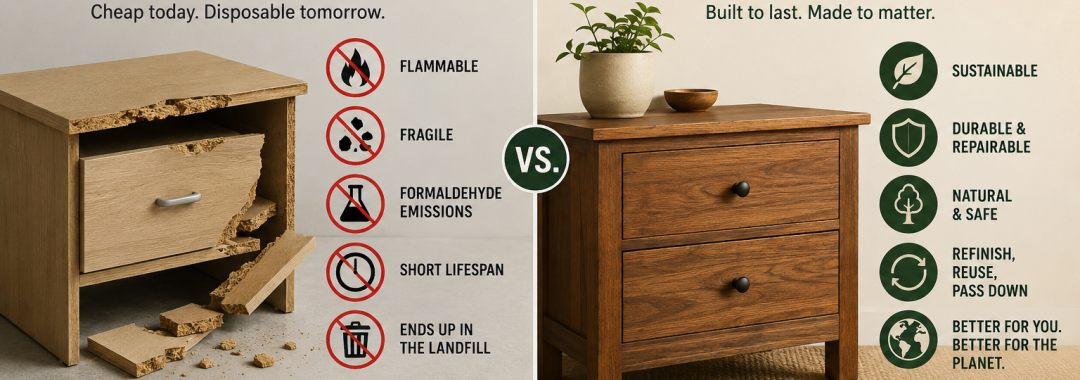
Many younger buyers — especially those in their early twenties — walk into big‑box furniture stores believing they’re purchasing sustainable, high‑quality pieces. What they’re actually buying is pressboard furniture, made from compressed sawdust and cardboard.
It’s marketed as eco‑friendly, but it’s not. It’s flammable, fragile, and short‑lived. The appeal is simple: it’s cheap.
For those unfamiliar, pressboard is created by pressing and heating layers of wood particles to form a fabricated “board.” It looks solid, but it’s not built to last. It’s the furniture equivalent of fast fashion — disposable, trendy, and ultimately wasteful.
The Sustainability Myth
Pressboard’s marketing mirrors that of the Toyota Prius — advertised as environmentally friendly, yet the production and disposal of its batteries leave environmental scars. Consumers equate “saving gas” with sustainability, just as they equate “saving money” with eco‑conscious furniture.
But sustainability isn’t about short‑term savings. It’s about longevity, repairability, and responsible materials — qualities pressboard simply doesn’t have.
The Marketing Disconnect
So how do we get rid of this secondhand furniture? The same way we handle any product that’s lost its shine — through smart marketing. Whether it’s a Boy Scout fundraiser, a new product launch, or even a spray‑on hair product promising youth, success depends on logical, targeted messaging.
If your marketing doesn’t make sense, neither will your results.
The Hidden Health Hazard
Let’s look deeper. Some particle boards are manufactured using urea formaldehyde resin, which releases formaldehyde gas — a known health hazard. When trapped indoors, that gas builds up, creating poor air quality and potential respiratory issues.
So not only is pressboard not eco‑friendly — it’s not safe. And when it’s discarded, it must be burned, adding yet another environmental burden.
The Assembly Experience
On the surface, pressboard furniture seems convenient. It’s lightweight, easy to transport, and comes in a flat box you can fit in your car. You get home, spread out the pieces, and start assembling — excited for the challenge.
Four hours later, you’re on the floor deciphering cryptic pictograms, searching for someone fluent in “Allen wrench hieroglyphics.”
That’s the first disadvantage. The second? Try moving it. Once dried out or exposed to moisture, it cracks, swells, and breaks. Pressboard furniture rarely survives more than three years — especially for renters or frequent movers. By the last move, it looks like a rummage‑sale relic.
The Turning Point
Furniture isn’t a big deal — until you move. That’s when cheap construction shows its true cost.
A recent story from The Professor’s House captured this perfectly:
“I finally replaced the pressboard jobs I had purchased only three years before. I bought high‑quality solid wood furniture. It’s beautiful. It didn’t take an assembly team or tools to make them functional, and the delivery people were wonderfully careful not to gouge up my house.”
That’s the difference between disposable and durable.
The Return to Real Wood
This isn’t about Victorian dark wood furniture — only a handful of collectors still chase that style. It’s about a new generation, 40 and younger, rejecting fast fashion and embracing solid wood furnishings.
Why? Because they’re sustainable. They can be re‑upholstered, refinished, reused, and passed down.
According to Barnebys, furniture sales in 2018 rose 32% over previous years, driven largely by younger buyers seeking mid‑century modern, colonial, and classic designs.
As Barnebys’ Pontus Silfverstolpe noted:
“Today it’s possible to buy a high‑quality object made by hand in the 1800s for less than the cost of a piece of IKEA furniture.”
The secondhand market has become more accessible, with buyers favoring craftsmanship and durability over quantity. Quality pays — not just for your wallet, but for the environment.
The Bottom Line
The eco‑friendly argument always circles back to the same truth: trees and time. Solid wood furniture is durable, repairable, and genuinely sustainable.
Buy solid wood first. It’s not just furniture — it’s a long‑term investment in quality, craftsmanship, and conscience.