Why Auctions Remain the Most Efficient Way to Sell Almost Anything

In every corner of the economy—from fine art and farmland to corporate assets and household contents—auctions keep proving themselves the cleanest, fastest, and often most lucrative method of sale. Fixed-price listings, negotiated deals, and traditional retail all have their place, but when the goal is true market discovery, speed, and finality, the auction format consistently outperforms.

The Core Advantages of the Auction Model

An auction does three things better than almost any other sales mechanism:

  1. It forces price discovery in real time. Multiple interested parties compete openly. The final price reflects what the market is actually willing to pay right now, not what a seller hopes or an appraiser guesses.
  2. It creates urgency and commitment. Bidding deadlines and the public nature of the process concentrate attention. Buyers who might “think about it” for weeks under a fixed-price listing suddenly have to decide.
  3. It delivers finality. Once the hammer falls (or the online clock hits zero), the item is sold. There is no lingering inventory, no endless price reductions, and no partial clearance.

These mechanics scale remarkably well. The same principles that drive a Sotheby’s evening sale of a Picasso also power a local estate auction of everyday furniture, a government surplus sale of used vehicles, or a commodity exchange trading wheat futures. Even modern digital marketplaces borrow heavily from auction theory—think of eBay’s original format, Google’s ad auctions, or the way many online lenders price loans.

Across the Economy, the Pattern Holds

  • Real estate: Absolute and reserve auctions routinely move properties that sat on the open market for months. Buyers compete, contingencies shrink, and closings happen on a fixed timeline.
  • Business and industrial assets: When companies restructure or liquidate, auctions clear machinery, inventory, and intellectual property faster and with less negotiation friction than private sales.
  • Collectibles, vehicles, and specialized goods: Specialty auctions attract concentrated pools of serious buyers who travel or bid remotely specifically for those categories.
  • Government and institutional sales: Tax-defaulted properties, seized assets, and surplus equipment almost always go to auction because it is transparent, defensible, and efficient.
  • Everyday commerce: Even supermarket “manager’s specials” and flash-sale platforms are essentially timed auctions dressed in retail clothing.

In each case the auction format reduces search costs, matches the right buyer with the right goods, and converts inventory into cash without the long tail of unsold merchandise.

A Clear Local Example: Estate Tag Sale vs. Estate Auction

Consider a typical residential estate. The family wants the house emptied so it can be listed or transferred. Two common approaches illustrate the difference.

A traditional estate tag sale (or multi-day yard sale) sets individual prices on furniture, housewares, tools, and personal items. Shoppers arrive, browse, haggle a little, and leave with what they want. The results are predictable: the desirable pieces sell, the mid-tier items move slowly at reduced prices, and a substantial volume of perfectly usable goods—odd chairs, boxes of kitchenware, older electronics, seasonal decorations, linens—remains behind. The family then faces a second round of disposal: donation runs, trash hauls, or another sale. Time stretches, labor multiplies, and residual value is lost.

An estate auction, by contrast, treats the entire contents as a single event. Everything is catalogued, photographed, and offered under competitive bidding—often both live and online. Bidders compete for lots large and small. Because the format attracts both local bargain hunters and remote specialty buyers, even ordinary items find new homes. At the end of the day the house is empty. The remaining proceeds are higher on aggregate, the timeline is compressed to days rather than weeks, and the family avoids the logistical headache of leftover inventory.

The difference is not theoretical. Auctioneers regularly report clearance rates of 90–100 % on well-promoted estate sales, while tag sales commonly leave 30–50 % of the volume behind. The auction simply converts more of the household’s residual economic value into cash and removes the burden of disposal.

Why the Preference Persists

Sellers ultimately care about three outcomes: net proceeds, speed, and certainty. Auctions deliver on all three more reliably than most alternatives when the goods are heterogeneous, the market is thin, or time is limited. Buyers benefit as well—they gain transparent access and the chance to acquire items at prices set by competition rather than arbitrary markups.

None of this means auctions are perfect for every transaction. High-volume identical retail goods still move best through fixed-price channels, and some unique properties benefit from patient private negotiation. But across the broad spectrum of economic activity—real estate, personal property, business assets, commodities, and digital advertising—the auction mechanism remains the preferred tool precisely because it is so effective at matching supply with demand under conditions of uncertainty.

When the goal is to turn “stuff” into money and empty a space (or a balance sheet) with minimal leftover friction, the auction is hard to beat. The estate that clears completely in one day, the farm equipment that finds its next owner without months of advertising, and the surplus inventory that converts to working capital overnight all tell the same story: open competition, timed urgency, and finality still outperform the alternatives.


Why “close enough” doesn’t cut it when a family’s estate is on the line

Picture this: your cable box goes dark on a Sunday afternoon, right in the middle of the game. You reach for the phone book — or these days, the search bar — and instead of calling a cable technician, you call a plumber.

He’s a good plumber, mind you. Twenty years in the trade. Licensed, bonded, insured. Shows up on time, shakes your hand, tells you not to worry because he’s “a professional.”

You’d probably still show him the door.

Not because there’s anything wrong with plumbers — heaven knows what would happen to your Sunday afternoon if a pipe burst instead — but because being good at one trade doesn’t make a person qualified in another. Nobody would hire a mechanic to perform a root canal, or a dentist to rebuild a transmission. Nobody would ask an electrician to cater a wedding, or a chef to rewire a house. It sounds absurd because it is absurd.

And yet, when families find themselves untangling an estate after the death of a parent or loved one, that same absurd logic often creeps in — quietly, and with far higher stakes than a broken TV.

When “Real Estate” Isn’t Really About Real Estate

The scenario usually starts simply enough. Mom or Dad has passed away, and there’s a house. Someone needs to sell it. Naturally, the family calls a real estate agent. Problem solved — or so it seems.

Except a house left behind by an estate is rarely just a house.

Walk through the front door of a typical estate property and you’ll likely find decades of accumulated life: furniture, tools, jewelry, firearms, artwork, family heirlooms, business records, three cars in various states of running. Somewhere there are unpaid utility bills, ongoing property taxes, and an insurance policy that needs to stay active. The lawn still needs mowing. The pipes still need to not freeze come winter. And often, there are heirs — sometimes scattered across three different states — who don’t agree on what should be kept, sold, donated, or thrown away.

The real estate agent, however skilled, was trained to price, market, and sell a house – that is all they are qualified. Nobody trained them to empty one first, to appraise Grandpa’s coin collection, or to referee a disagreement between siblings over who gets the china cabinet.

That’s the distinction worth sitting with – the house is only one asset inside the estate. Treating the estate as though it were simply a real estate transaction is like treating a heart attack as though it were simply chest pain — technically related, but missing almost everything that actually matters.

I have sat in Clerk of Courts all around the state where real estate brokers were being disciplined because they threw away $50,000 dollar coin collections, as well as other highly marketable valuables just to chase the commission check of the property. 

The Auction Block Has Its Own Rules, Too

The same logic applies on the other side of the process, when it comes time to actually sell what’s inside the house — or the house itself — at auction.

Would you hire an attorney to call your auction?  

Almost certainly not, and for good reason. An attorney may understand probate law inside and out, may draft an airtight contract, may be exactly the person you need sitting across the table when legal questions arise. But conducting an auction is its own profession entirely, with its own body of knowledge: cataloging and lotting items, setting reserve prices, photographing and marketing a sale, registering and qualifying bidders, running auction software, managing live and online bidding simultaneously, processing payments, coordinating removal, and — perhaps above all — knowing how to build genuine competition among buyers so that an item sells for what it’s actually worth, not just what the first bidder offers.

This is the very reason many people paint auctions with a broad negative brush, because attorneys are hired to sell property at the courhouse steps, and they aren’t experienced to do so.  What happens?  Pennies on the dollar.  But Real Estate Agents blame the auctioneer – when it’s the attorney.

An attorney doesn’t become an auctioneer because the sale happens to arise out of a probate case. And an auctioneer certainly doesn’t become an attorney because the auction happens to involve an estate.

Not an Argument Against Anyone — Just an Argument for the Right Someone

None of this is a knock on real estate agents or attorneys. Quite the opposite. A properly handled estate often needs both — and an accountant, an appraiser, a title professional, and a cleanout crew besides. Each of these professionals brings real, necessary value.

The mistake isn’t hiring them. The mistake is assuming that hiring one means you’ve covered them all.

It’s the same reasoning that governs medicine. Nobody facing brain surgery says, “She’s a doctor, she’ll be fine,” and stops there. They ask what kind of doctor. They look for a neurosurgeon. The fact that cardiologists, ophthalmologists, and neurosurgeons all carry the title “physician” doesn’t make them interchangeable — and the same holds true across the professions that circle around an estate.

The Better Questions to Ask

Families navigating this process for the first time — and most only do it once or twice in a lifetime — would do well to swap out one kind of question for another.

Instead of asking “Are you a real estate agent?” the better question is: How much experience do you have handling estates specifically including Real Estate In Probate?

Instead of asking “Are you an attorney?” the better question is: How much experience do you have running auctions?

Instead of asking “Are you an auctioneer?” the better question is: How much experience do you have with probate and estate administration?

Credentials matter. Licenses matter. But experience and specialization matter just as much, and in an area as emotionally and financially significant as settling a loved one’s estate, they may matter more.

Who Can See the Whole Picture?

So who should a family actually call?

For legal questions, an attorney who practices in probate and estate law. For tax matters, a qualified tax professional. For selling real property, a competent real estate broker experienced with probate sales specifically. For liquidating personal property, an experienced auctioneer who understands how to turn a houseful of belongings into fair value at the auction block.  

And when an estate needs several — or all — of these things at once, the ideal is someone who understands how the pieces fit together: not by pretending to be the attorney, the CPA, or the contractor, but by knowing precisely where their own expertise ends and someone else’s begins. A genuine estate specialist should be able to answer, without hesitation, four simple questions: What do I handle? What does the attorney handle? What does the auctioneer handle? What does the real estate broker handle? And just as important — when is it time to bring another professional into the room?

How should we think about professions?

Nobody would call a plumber to fix a cable box, a dentist to fix a transmission, or a mechanic to perform surgery. The idea is laughable precisely because everyone instinctively understands that a license in one field doesn’t transfer to another.

The same principle deserves the same respect when it comes to settling an estate. A real estate license doesn’t make someone an estate specialist. An attorney’s bar card doesn’t make them an auctioneer. An auctioneer’s gavel doesn’t make them a lawyer.

The best professionals know exactly what they know — and, just as importantly, they know what they don’t.  They charge for their knowledge and their experience. When a family’s entire life’s possessions, property, and relationships are on the line, “close enough” is never a qualification to begin with.

Hire the right professional for the right job. Why would anyone hire the wrong specialist to handle an estate?

I Don’t Offer Buyer’s Agent Compensation — And Why That’s Actually Good for You

If you’ve shopped for a home or bid on a property lately, you’ve probably noticed something has shifted in real estate. For decades, it was standard practice for the seller — through the listing broker — to pay the commission for the buyer’s agent too. It felt free. It felt normal. Almost nobody questioned it.

I do question it. And after fourteen years of standing on both sides of the auction block and the closing table, I’ve made a deliberate business decision not to offer buyer’s agent compensation on my listings. I want to explain why — not as a marketing angle, but as a matter of principle rooted in something every licensed professional is supposed to take seriously — fiduciary duty.

Start With a Simple Question

Would you ever accept a settlement offer from a lawsuit where the opposing party’s attorney was being paid by your side?

Nobody would agree to that. It doesn’t matter how good the attorney is, how well-intentioned they are, or how many disclosures get signed. The moment your adversary’s counsel is compensated by the person across the table from them, the integrity of the arrangement is compromised. We don’t need a law degree to sense that something is wrong with it — it’s wrong on its face.

Real estate works the same way, whether the industry wants to admit it or not.

The Buyer’s Agent Is Supposed to Work for the Buyer

A buyer’s agent owes a fiduciary duty to the buyer. Loyalty. Full disclosure. Good faith negotiation. Advocacy for the buyer’s best price and best terms — even when that means pushing hard against the seller.

The seller’s agent — in my case, as the auctioneer and listing broker — owes that exact same duty, but to the seller. My job is to get the best price and best terms for the person who hired me. That’s not a conflict. That’s the whole point of representation.

Now ask yourself what happens when the seller’s side is the one writing the check to the buyer’s agent.

Suddenly the person whose job is to advocate against my client is being paid by my client. The buyer’s agent’s paycheck is now tied — directly or indirectly — to the outcome the seller’s side controls. That is precisely the arrangement we’d never tolerate from opposing attorneys, and for the same reason — it introduces a financial incentive that runs against undivided loyalty.

It doesn’t matter whether it’s dressed up as “cooperating compensation,” baked into a commission split, or offered as a courtesy on the listing. The structure is the same. One side is financially beholden, at least in part, to the party it’s supposed to be negotiating against.

Why This Matters Even More at Auction

In a traditional negotiated sale, this conflict is troubling. At auction, it’s magnified.

The entire premise of an auction is genuine price discovery — letting real, motivated buyers compete openly to establish true market value, without artificial floors, steering, or hidden incentives distorting the outcome. When a buyer’s agent’s compensation is subsidized by the seller’s side, you introduce a variable that has nothing to do with what the property is actually worth and everything to do with how commissions are structured behind the scenes.

Did that agent bring their buyer to my auction because it was the best fit for their client — or because the compensation offered was more attractive than at the property down the road? Did that agent negotiate as hard as they could for their buyer, or temper their advocacy because the check was coming from the other side of the transaction? I can’t answer that for other auctioneers or other listings. I can control it for mine.

What I Do Instead

I don’t offer buyer’s agent compensation because I believe fiduciary duty should mean something — not just to me, but to every professional at the table. If a buyer chooses to work with their own agent, that’s entirely their right, and I’ll cooperate with that agent professionally and transparently. But that agent’s compensation is a conversation between the buyer and their own representative, negotiated directly, the same way you’d negotiate with your own attorney.

That keeps incentives clean. It keeps my duty to my seller intact. It keeps the buyer’s agent’s duty to their buyer intact. And it keeps the price discovery at auction honest — which, frankly, is the entire reason someone hires an auctioneer in the first place.

The Bottom Line

You wouldn’t want your attorney paid by the person suing you. You shouldn’t want your real estate representation paid by the person on the other side of your transaction, either. It’s not about who has to write the check. It’s about who that check makes you beholden to.

I built my practice around undivided loyalty — to my sellers, and to the integrity of the process itself. That’s not always the popular position in an industry that’s grown comfortable with the old way of doing things. But it’s the right one.

How to Sell Real Estate and Personal Property in Probate

This Step-by-Step guide is for you.

By Matthew Price, Auctioneer and Real Estate Broker

When a parent, spouse, grandparent, or other family member dies, the family is often left with a question nobody wants to have to ask:

“What do we do with all of this property?”

Sometimes the answer is simple. The family keeps the house and divides the personal belongings among the heirs.

Other times, the estate needs to sell everything—the house, vehicles, furniture, collectibles, tools, jewelry, household goods, and other personal property—to pay debts, divide the proceeds among heirs, or simply settle the estate.

That creates another question:

“How do I sell property that is in probate?”

If you have then become a search master searching for all of these terms:

  • “How do I sell real estate in probate?”
  • “How do I sell my parents’ house after they die?”
  • “How do I sell my deceased mother’s house?”
  • “How do I sell my deceased father’s house?”
  • “How do I sell my deceased parents’ house?”
  • “Can I sell a house while it is in probate?”
  • “Can an executor sell a house?”
  • “Who can sell a deceased person’s house?”
  • “How do I sell an inherited house?”
  • “How do I sell personal property in probate?”
  • “What happens to the furniture when someone dies?”
  • “How do I clean out and sell an estate?”
  • “Should I use an estate sale or an auction?”
  • “Do I have to wait until probate is finished to sell the house?”

—you are in the right place.

Whether you are handling a single-family home filled with decades of personal belongings, rural land, or personal property assets, navigating the probate process requires legal authority, clear valuation, and an efficient liquidation strategy.

Confirm Your Legal Authority to Sell

You cannot sign a real estate listing agreement, execute an auction contract, or transfer a deed simply because you are named as an executor in a will or are the closest surviving heir.

Before taking action, you must be officially appointed by the Clerk of Superior Court or probate court in the county where the deceased resided or where the property is located.

  • Letters Testamentary:Issued if the deceased left a valid Last Will and Testament naming you as the Executor.
  • Letters of Administration:Issued if there was no will (dying intestate) and the court appoints you as the Administrator.

Until you hold these court-issued documents, you do not have legal authority to sell property belonging to the estate.

Check the Title and the Will

The pathway to selling an inherited home depends heavily on how the property was titled and what power is granted in the will, sometimes attorneys get real estate ownership wrong, so here is your reference:

  • Joint Tenancy with Right of Survivorship (JTWROS):If you or another heir were on the deed as a joint owner with rights of survivorship, the property transfers automatically outside of probate upon filing a death certificate and survivor’s affidavit.
  • Explicit “Power of Sale” in the Will:If the will specifically grants the executor the power to sell real property, you can generally market and sell the home without petitioning the court for individual approval at each step.
  • No Power of Sale or Intestate Estate:If there is no will, or if the will is silent on selling real estate, you must file a special proceeding or petition with the court for permission to sell.In many jurisdictions, sales without explicit power of sale are subject to court confirmation and mandatory upset bid periods.

Step-by-Step Execution: Personal Property & Real Estate

Step 1: Secure the Property and Maintain Utilities

Immediately secure the home, change locksets if necessary, maintain homeowner’s insurance, and keep basic utilities active. Unoccupied homes deteriorate quickly, and maintaining utilities ensures winterization protection and allows prospective buyers or auction participants to inspect the premises safely.

Step 2: Establish Date-of-Death Fair Market Value

To protect the estate from tax complications and distribute assets fairly, obtain a formal appraisal as of the date of death.Inherited assets typically benefit from a stepped-up basis, meaning the tax basis resets to the fair market value on the date of death.Selling close to that appraised value minimizes or eliminates capital gains taxes for the heirs.

Step 3: Inventory and Sort Personal Property

Before marketing the real estate, address the contents of the house using a structured sorting system:

  • Keep: Sentimental family heirlooms, legal/financial documents, and items identified in specific devises within the will.
  • Sell: Furniture, vehicles, tools, collectibles, and household goods of value.
  • Donate/Dispose: Items with low commercial value that can be gifted to local charities or removed during a site clean-out.

Choose the Right Selling Method (Auction vs. Traditional Listing)

As both a licensed real estate broker and auctioneer, I routinely evaluate whether a traditional real estate listing or an estate auction provides the cleanest outcome:

Liquidation MethodBest Suited ForAdvantages
Estate Real Estate & Contents AuctionHomes needing significant repair, estates with extensive personal property, or when an expedited timeline is necessary.Sells “as-is” with no repair contingencies, sets firm closing dates, and liquidates real estate and personal property simultaneously.
Traditional Brokerage ListingTurn-key homes in high-demand residential neighborhoods where maximizing retail exposure to buyer-financing is preferred.Attracts traditional buyers using conventional or FHA mortgage financing.

Traditional Real Estate, however, puts you, as the executor in a bind, especially in a balanced market. The home may sit on the market for well over several months to half a year and have no showings. So the marketing needs to be more urgent in nature, which a Real Estate Auction will allow you to have it marketed more urgently, and have the property sold in many cases, less time than a traditional sale.

Step 5: Publish Notice to Creditors and Clear Title

Before proceeds can be distributed to heirs, you must publish a formal Notice to Creditors in a local newspaper of general circulation.This opens the statutory period for valid debts (medical bills, credit cards, mortgages) to be presented against the estate. Title insurance companies typically require this step to be complete before issuing a clear title policy to a buyer.

Step 6: Close the Sale and Deposit Funds into an Estate Account

All proceeds from the sale of real estate or personal property must be deposited into a dedicated estate checking account opened under the estate’s Federal Employer Identification Number (EIN), never into a personal bank account. The personal representative then satisfies valid claims, administrative fees, and taxes before making final distributions to beneficiaries according to the court-approved final accounting.

Key Pitfalls to Avoid

  • Distributing funds prematurely: Paying heirs before all creditor notice windows expire leaves the executor personally liable for unpaid estate debts.
  • Over-improving the home: Making costly capital renovations prior to sale rarely yields a full return on investment in probate situations; selling “as-is” via auction or standard market listing is often more cost-effective.
  • Discarding items before valuation: Personal property that appears to be clutter can hold significant antique or collectible value. Always have a qualified auctioneer or appraiser review contents before hosting a dump run.

Navigating Probate with Experienced Support

Handling an estate after someone passes away can feel overwhelming, even for the most organized families. The person responsible—called an executor or administrator—is suddenly balancing funeral arrangements, family dynamics, and their own job and daily life. At the same time, they must navigate a legal process that is often unfamiliar, time‑sensitive, and full of moving parts.

This is where Matthew Price, Auctioneer & Real Estate Broker, becomes an essential resource. Our team handles a large number of real estate auctions, manages significant volumes of personal property, and brings more than 35 years of combined business experience to every estate we serve. That background allows us to guide families through probate with clarity, structure, and confidence.

A Multi‑Layered North Carolina Estate

Recently, we assisted with an estate that included:

  • Household items and everyday personal property
  • Collectibles and specialty items
  • A large gun collection
  • A residential property in Sanford with potential commercial value
  • Farmland in Lee County

The executor—an adult child living out of state with a full‑time professional career—needed a solution that was efficient, legally compliant, and easy to manage from a distance.

Step 1: Personal Property Strategy

The items inside the home were not ideal for a full, live auction on‑site. After evaluating the contents, we recommended a tag sale for the everyday household items. This approach helped reduce costs and allowed the executor to convert a large portion of the property quickly.

For the more valuable pieces—collectibles, specialty items, and the gun collection—we conducted an online‑only auction using our bidding platform. This expanded the buyer pool, increased competition, and ensured the estate received strong market value.

Step 2: Real Estate Strategy

The home itself was a strong candidate for a live real estate auction, and it performed well in the market. Just as important, the entire process was organized, documented, and simplified for the executor, who was able to make decisions confidently without needing to travel back and forth.

Step 3: Farmland Guidance

The family is still deciding how to handle the farmland. In the meantime, we prepared a Broker’s Opinion of Value to help the executor understand the property’s potential worth and to provide the probate court with the information it needed. When the family is ready, our Farm & Ranch division is prepared to manage the marketing and sale.

This Matters in Probate Because…

Situations like this are common. Estates often include a mix of personal property, real estate, specialty items, and land—each requiring a different strategy. What makes the difference is having the right experience and the right team guiding the process.

In addition to marketing and selling real estate, we assist with many other estate responsibilities, including:

  • Selling real estate and personal property
  • Preparing Broker Opinions of Value
  • Providing personal property appraisals
  • Coordinating property maintenance
  • Arranging clean‑out and trash removal
  • Communicating with attorneys and estate professionals

Because of this comprehensive approach, we are a strong, reliable resource for probate attorneys and the families they serve. We help reduce stress, shorten timelines, and ensure the estate is handled professionally from start to finish.

Closing Your Business? A Professional Liquidation Can Make All the Difference

Few business owners begin their journey thinking about how it will eventually end. Whether you’re retiring after decades of hard work, moving into a new venture, or simply deciding it is time to close the doors, every business eventually reaches a point where its assets must be converted into cash. That process is known as liquidation, but successful liquidation is far more than simply selling equipment. It is the careful marketing of an entire business’s assets to produce the highest possible return while meeting legal and financial obligations.

Many owners assume liquidation means putting a few items on Facebook Marketplace, eBay, or another online marketplace and waiting for buyers to appear. While that approach may work for a lawn mower or an old desk, it rarely produces the best results for an entire business. Commercial equipment, machinery, vehicles, inventory, furniture, intellectual property, and even real estate each appeal to different types of buyers. Reaching those buyers requires a coordinated marketing effort, not dozens or hundreds of individual listings scattered across the Internet.

The first step in any business liquidation is understanding exactly what the business owns. Most people immediately think of equipment and inventory, but those are only part of the equation. Office furniture, computers, vehicles, trailers, shelving, manufacturing equipment, tools, and real estate all have value, but so do less obvious assets. Security deposits, refundable insurance premiums, customer deposits, accounts receivable, and prepaid services can often be converted into cash as well. Before any sale begins, these assets should be identified, documented, and evaluated so that nothing of value is overlooked.

Just as important are the intangible assets that many owners forget they possess. A recognizable business name, established website, customer database, telephone numbers, trademarks, copyrights, patents, supplier agreements, and favorable lease terms may all carry significant value. Competitors entering your market may have little interest in your desks or filing cabinets, but they may be willing to pay a premium for years of customer relationships or a respected brand name. In today’s economy, intangible assets frequently represent a substantial portion of a company’s overall value, and they deserve the same level of marketing attention as any physical asset.

This is where many business owners unintentionally leave money on the table. Liquidation is often viewed as simply disposing of unwanted property, but professional auctioneers understand that liquidation is actually a marketing business. The objective is not merely to sell; it is to create competition among qualified buyers. Every additional bidder increases the likelihood of achieving true market value. Modern auction marketing combines targeted email campaigns, industry databases, social media advertising, search engine marketing, direct outreach to equipment dealers and investors, and national advertising to expose assets to buyers who are actively searching for them. Instead of hoping someone local happens to need a particular piece of equipment, a professionally marketed auction places that equipment in front of buyers across the country—and sometimes around the world.

Many owners underestimate the amount of time required to sell an entire business one item at a time. Every listing requires photographs, descriptions, pricing, communication with prospective buyers, scheduling inspections, negotiating terms, collecting payment, and coordinating pickup or shipping. Multiply that process by several hundred assets, and what appears to be a cost-saving measure quickly becomes a full-time job. Meanwhile, the business continues to incur expenses. Insurance premiums continue, utilities remain connected, rent or mortgage payments continue, property taxes accumulate, and valuable management time is consumed by selling instead of planning the next chapter. A professionally managed auction compresses months of individual sales into a coordinated marketing campaign followed by a defined sale period, allowing the business to move forward more efficiently.

One of the most common questions owners ask is, “What is my equipment worth?” Unfortunately, the answer is almost never what they originally paid for it. Neither purchase price nor replacement cost determines fair market value. Fair market value is simply the price that a willing buyer is prepared to pay a willing seller after the asset has been exposed to the open marketplace. Advertised asking prices on websites often bear little resemblance to actual selling prices. Insurance values are designed to replace equipment, not measure resale value. Appraisals provide useful guidance, but they still represent an opinion. The marketplace ultimately decides value, and nothing demonstrates current market value more effectively than competitive bidding among qualified buyers.

Business owners also have important legal responsibilities throughout the liquidation process. If the company has outstanding debts, owners cannot simply transfer valuable equipment to friends or relatives for a fraction of its value or hide assets from creditors. Depending upon the financial condition of the business, owners, officers, managers, and directors may owe fiduciary duties to creditors as well as shareholders. Assets should be marketed openly and sold in a transparent manner that demonstrates every reasonable effort was made to obtain fair market value. Proper documentation and competitive marketing not only maximize returns but also help protect owners from future claims that assets were improperly disposed of.

Some assets require additional attention before they can be sold. Equipment financed through banks or leasing companies may be subject to liens or lease agreements that limit an owner’s ability to sell without the lender’s approval. Vehicles often carry title liens, and machinery may have Uniform Commercial Code filings attached to it. Before liquidation begins, these interests should be identified so lenders, attorneys, accountants, and auctioneers can coordinate an orderly disposition that satisfies all legal requirements. Resolving these issues before the sale prevents delays and gives buyers confidence that clear title can be transferred.

While owners naturally focus on physical assets, outstanding accounts receivable deserve equal attention. Money owed to the business becomes increasingly difficult to collect once operations cease. Customers may delay payment or assume no one is monitoring collections. Collecting receivables before closing often produces the greatest recovery, although businesses may also consider selling receivables to a factoring company when immediate cash flow is more important than collecting the full balance over time.

Another frequently overlooked opportunity involves recovering money that has already been paid. Workers’ compensation premiums, liability insurance, utility deposits, prepaid service contracts, and other refundable expenses can often generate additional cash during the wind-down process. Individually these amounts may seem small, but together they can significantly improve the final financial outcome.

For business owners who lack the time, experience, or desire to manage every aspect of liquidation themselves, hiring a professional auctioneer can dramatically simplify the process. An experienced auctioneer develops the marketing strategy, prepares the inventory, photographs and catalogs the assets, coordinates inspections, manages bidder registration, conducts the auction, collects payment, supervises asset removal, and provides a complete accounting after the sale. Instead of managing hundreds of individual transactions, the owner works with one experienced professional whose responsibility is to maximize exposure and produce competitive bidding.

Matthew Price, Auctioneer & Real Estate Broker specializes in helping business owners transition through this important stage. Whether the business consists of a restaurant, retail store, manufacturing facility, construction company, automotive shop, office complex, or commercial real estate portfolio, every liquidation begins with the same objective: exposing the assets to the largest possible audience of qualified buyers. Through extensive marketing, nationwide buyer outreach, and transparent auction methods, assets receive the competitive exposure necessary to achieve current market value rather than simply accepting the first available offer.

Closing a business represents the end of one chapter, but it should not mean leaving money behind. A properly planned liquidation transforms years of investment into capital that can satisfy creditors, meet legal obligations, and provide owners with the strongest possible financial position for whatever comes next. With professional guidance, strategic marketing, and competitive bidding, liquidation becomes more than simply selling assets—it becomes the final successful transaction of the business itself.

Family Real Estate in Probate Can Be Easy, Or Expensive.

When you are in a situation where your family has an issue with how things are going in an estate, it could be a simple fix or an expensive fix.   This is because when it comes to Real Estate, your broker can only do so much in order to facilitate the sale, the rest is up to the seller and buyer.

So let’s get some definitions out of the way to help you understand the process.  

First, intestate is defined as a person who has passed away without a will.   “But it was on his or her computer!” that does not make any difference.   The last will and testament needs to be witnessed and notarized to be a legal document.    

Second, intestate succession act is a North Carolina Law which says that if a person dies without a will, then the ownership of the property transfers immediately to the heirs or beneficiaries. 

Third, if a person passes away with a Last Will and Testament, they are to have passed testate, in which all of the functions of the Will is to be carried out by the Executor.  Each piece of what needs to happen is expressly written in North Carolina law – regardless of what the siblings or beneficiaries want, if it is spelled out, they can’t have their way – it’s the law.  But in the area of real estate, it can be completely upside down with or without a will.

Let’s give an example.  Frank and Bob and their two sisters, Sue and Brenda’s parents passed away.   The will did not expressly state that the real estate goes to anyone, or into the estate.  This means Title to real property owned in name of the decedent, or a decedent’s interest in real property owned as a tenant in common (equal and undivided shares), generally passes to beneficiaries or heirs pursuant to the terms of the decedent’s will or North Carolina intestacy law.

Tenants in common own an undivided interest in the property with full right of enjoyment of the entire property. The property is not partitioned or subdivided. With tenancy in common, however, there is no right of survivorship. When an owner dies, his or her interest passes through probate to heirs. It does not flow through to the other owners.   In this situation, Owner A cannot have Owner B pay for rent, as Owner B is an Owner.     If Owner A passes away, owner A’s ownership does not go to Owner B, but to Owner A’s children.   The only way that Owner B can have full ownership is of Owner B purchases the ownership from Owner A’s children.

Frank was named Executor, but does not have authority to sell the property in the will.  At the time of death, Frank, Bob, Sue and Brenda are considered Tenants in Common.  While the word “Tenants” is confusing, it means ownership interest.  Much like a tenant in an apartment, who also has an ownership interest. 

Sue decides to hire a real estate broker to sell the property and did not tell the other three.  Because Sue don’t own the entire property, one tenant in common can’t sell the entire piece of land or a home without permission from all of the co-owners. If, however, all of the co-owners agree, the property can go on the market and get sold.

Sue has contacted a Real Estate Broker and they all agreed to list the property, and there is an offer on the table, but one person, Frank’s wife refuses to sign because she don’t want Bob to get a dime.   On closing of the Real Estate transaction, you can’t stop the disposition of money to the heirs.     Frank’s wife’s infantile response is out of Jealousy, and if serious enough, could lead to legal proceedings that can cost hundreds of thousands of dollars.

Here’s a sub-example.   Frank, Bob, Sue and Brenda’s property is valued at $125,000 and they got an offer for $200,000.   Frank’s wife refuses to sign the paperwork because she don’t want Bob to get money from the sale.   Brenda does not want to continue to pay taxes on land that she will not be able to use since she lives 9 hours away.   Because of Frank’s wife, Brenda hires an attorney who in turn files a “Petition to Partition.”

What Brenda has done is asked the Courts to sell the property, even if everyone else did not want the sale forced.   The courts assign a commissioner to sell the property, and they do it right on the courtroom stairs.  The court distributes the share of the profits to each co-tenant in relation to their ownership interests.

What is the difference in the two scenarios?  Well, when you place property up for sale and get all of the appropriate signatures it is much easier.   Your family splits the proceeds from sale at Market Price.  When Brenda files for a Petition to Partition, not only do you lose any potential equity, but you also lose cash money in hand.  Why?   When it is sold on the courtroom steps, it goes for 1/10th of a dollar on average – we call it fire sale prices.  Most of the people who bid on property on the steps are investors.

Once the Petition has been filed, the other owners commonly do not have any redress, which is method to stop it.   Once the commissioner says sold on the courthouse steps, the property is no longer yours, and if he gets $10,000 for a $200,000 property, your split is out of the $10,000, minus fees, filing fees, as well as the processing fees.  In the case of Brenda, she may be lucky and have a check for $1,000, but the drama is over and she can move on.

No One Wants Your Used Clothes Anymore

For decades, the donation bin has served as a convenient moral release valve for consumers in wealthy nations — a place to drop last season’s shirts, impulse‑buy dresses, and fast‑fashion castoffs with the comforting belief that these garments would find a second life. In the background, a vast commercial ecosystem quietly handled the flow: global traders collected, sorted, graded, and shipped used clothing to markets where it could be reworn, repurposed, or recycled into industrial materials. This system moved more than 24 billion items of clothing annually and generated over $4.9 billion in trade value by 2024 .

But that once‑stable cycle is now breaking down. Fashion trends are accelerating at unprecedented speed, and ultra‑cheap new clothing increasingly competes directly with secondhand garments. At the same time, many low‑income countries — historically the largest importers of used clothing — are restricting or rejecting secondhand imports due to concerns about waste colonialism, environmental harm, and damage to domestic textile industries . Without major changes in how clothing is produced, consumed, and marketed, the world is heading toward a textile‑waste crisis of staggering proportions.

No place feels this shift more acutely than Panipat, India, a dusty industrial city of roughly 450,000 residents located 55 miles north of Delhi. For more than two decades, Panipat has been the world’s largest recycler of woolen garments — a critical pressure valve for the global used‑clothing trade. The city processes hundreds of thousands of tonnes of textile waste annually, with some estimates reaching 1 million tonnes per year across more than 20,000 industrial units and a workforce of at least 300,000 people . Its recycling cluster generates more than ₹1,30,000 crore (€13 billion) in turnover and exports around ₹30,000 crore (€3 billion) worth of goods annually .

Panipat’s mills historically specialized in shoddy — a low‑grade yarn produced by shredding discarded woolen garments. Shoddy became the backbone of the global relief‑blanket market. At its peak in the early 2010s, Panipat produced 100,000 blankets per day, supplying 90% of the world’s disaster‑relief blankets. But the economics of shoddy have shifted dramatically. Beginning in the early 2000s, Chinese manufacturers invested in modern, high‑capacity mills capable of producing far more blankets in a wider range of colors and at competitive prices. Today, a new polar‑fleece blanket retails for about $2.50, barely more than the $2.00 cost of a recycled shoddy blanket — a price gap so small that most relief agencies now prefer new fleece products .

As a result, Panipat’s traditional shoddy industry has contracted sharply. In 2013, virtually no local mills produced new fleece blankets; today, around 50 mills do, many using Chinese‑built machinery. Ramesh Woolen Mills, for example, doubled its daily output after installing a modern fleece line in 2016, shifting two‑thirds of its production to polar fleece. Consumers appreciate the improved quality, color variety, and rapid turnaround times — but this pivot has profound consequences for the global waste stream.

Even if Panipat were still operating at its shoddy peak, it could not absorb the tidal wave of clothing now entering the waste pipeline. Between 2000 and 2015, global clothing production doubled, while the average number of wears per garment fell by 36% — and by 70% in China, where fast fashion dominates consumption patterns . The result is a bleak paradox: the volume of secondhand clothing is exploding, even as the markets capable of reusing or recycling it are shrinking.

The environmental implications are severe. The textile industry already produces more greenhouse‑gas emissions than all international flights and maritime shipping combined, and as recycling markets collapse, more clothing will be incinerated or landfilled, accelerating emissions and pollution. Meanwhile, the human cost is rising. Panipat’s workers — many of whom sort and shred clothing without protective gear — report chronic respiratory illness, skin conditions, and other health issues linked to constant exposure to lint, dyes, microplastics, and chemical residues .

The industry knows it must change. Climate change threatens cotton yields, water availability, and supply‑chain stability, making garment production more expensive and unpredictable. Some brands, including H&M and Patagonia, are experimenting with recycled fibers and closed‑loop systems. Others are exploring durability‑focused strategies such as warranties, lifespan labeling, and repair guarantees. Subscription‑based fashion rental models — like China’s YCloset — offer another potential path for satisfying consumer appetite for novelty while reducing waste.

Still, none of these emerging solutions can fully replace the role once played by Panipat and other mill towns that transformed wealthy nations’ castoffs into affordable goods for the world’s poor. That era is ending. The challenge now is to build a new system — one that aligns production with planetary limits, protects workers, and reduces the relentless churn of disposable fashion.

The global secondhand trade is no longer a virtuous cycle. It is a warning signal. And the world must listen.

Online Auctions Are the Ultimate Choice for Estates

When the time comes to transition an estate, liquidate business assets, or streamline inventory, choosing the right method to sell can make all the difference. For decades, traditional live auctions were the standard approach. Today, however, online auctions have emerged as the absolute gold standard—offering unmatched convenience, global reach, and superior financial returns for families and business owners alike.

The Power of Global Reach

Traditional live auctions are inherently limited by geography and venue size. If a buyer cannot physically travel to a specific tent, warehouse, or property on a designated day and time, they miss out entirely.

Online auctions completely shatter these physical barriers. By bringing your catalog to the internet, your items are placed directly in front of a worldwide audience of eager buyers, collectors, and institutional investors. Instead of relying on a handful of local attendees, online platforms spark competitive, multi-day bidding wars that drive true market value for every asset.

Extended Bidding Windows and Less Pressure

A live auction is a high-pressure, fast-paced event that often lasts only a few hours, meaning valuable items can easily be overlooked or undersold if the right buyer happens to be busy that afternoon.

Online auctions extend the bidding process over multiple days. This gives prospective buyers ample time to thoroughly examine high-resolution photographs, read detailed descriptions, and carefully consider their bids. This thoughtful, stress-free environment results in higher engagement, stronger bidder confidence, and ultimately, better financial outcomes for you.

Maximum Efficiency and Cost-Effectiveness

Managing physical crowds, renting large venues, and coordinating heavy on-site staffing can quickly eat into your proceeds. Online auctions streamline the entire process. Assets can be cataloged, photographed, and marketed efficiently while remaining securely in place or in a controlled storage environment. This dramatically reduces overhead expenses related to physical setup and venue rentals, meaning more money stays directly where it belongs: in your pocket.

A Seamless Experience from Start to Finish

Whether you are an estate executor managing a complex household liquidation or a business owner scaling down operations, you deserve a process that is transparent, organized, and stress-free. Modern online auction platforms provide robust reporting, secure digital payment processing, and streamlined logistics that make managing your sale effortless.

Partner with the Experts

Transitioning assets doesn’t have to be overwhelming. By leveraging the power of online auctions, you can turn a complex liquidation into a smooth, highly profitable experience.

Ready to get started? Contact us today to discover how our customized online auction solutions can maximize the value of your estate or business assets with one simple call.

Sustainability in A Throw-Away Culture

Today I read an article claiming you can buy top‑quality furniture for less than what you’d pay at IKEA, Walmart, or Rooms‑To‑Go — companies that have mastered selling what today’s young buyers think they want.

But here’s the problem: when you don’t understand the culture you’re marketing to, you misunderstand the people themselves — and how they perceive value.

The Pressboard Illusion

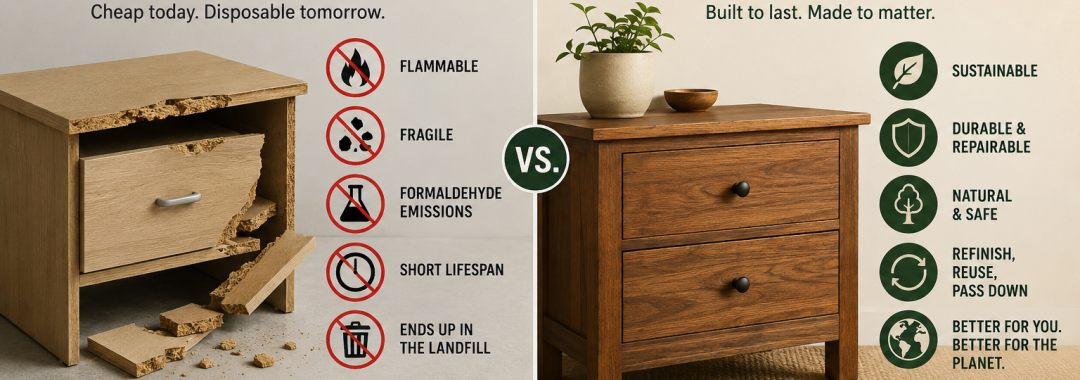
Many younger buyers — especially those in their early twenties — walk into big‑box furniture stores believing they’re purchasing sustainable, high‑quality pieces. What they’re actually buying is pressboard furniture, made from compressed sawdust and cardboard.

It’s marketed as eco‑friendly, but it’s not. It’s flammable, fragile, and short‑lived. The appeal is simple: it’s cheap.

For those unfamiliar, pressboard is created by pressing and heating layers of wood particles to form a fabricated “board.” It looks solid, but it’s not built to last. It’s the furniture equivalent of fast fashion — disposable, trendy, and ultimately wasteful.

The Sustainability Myth

Pressboard’s marketing mirrors that of the Toyota Prius — advertised as environmentally friendly, yet the production and disposal of its batteries leave environmental scars. Consumers equate “saving gas” with sustainability, just as they equate “saving money” with eco‑conscious furniture.

But sustainability isn’t about short‑term savings. It’s about longevity, repairability, and responsible materials — qualities pressboard simply doesn’t have.

The Marketing Disconnect

So how do we get rid of this secondhand furniture? The same way we handle any product that’s lost its shine — through smart marketing. Whether it’s a Boy Scout fundraiser, a new product launch, or even a spray‑on hair product promising youth, success depends on logical, targeted messaging.

If your marketing doesn’t make sense, neither will your results.

The Hidden Health Hazard

Let’s look deeper. Some particle boards are manufactured using urea formaldehyde resin, which releases formaldehyde gas — a known health hazard. When trapped indoors, that gas builds up, creating poor air quality and potential respiratory issues.

So not only is pressboard not eco‑friendly — it’s not safe. And when it’s discarded, it must be burned, adding yet another environmental burden.

The Assembly Experience

On the surface, pressboard furniture seems convenient. It’s lightweight, easy to transport, and comes in a flat box you can fit in your car. You get home, spread out the pieces, and start assembling — excited for the challenge.

Four hours later, you’re on the floor deciphering cryptic pictograms, searching for someone fluent in “Allen wrench hieroglyphics.”

That’s the first disadvantage. The second? Try moving it. Once dried out or exposed to moisture, it cracks, swells, and breaks. Pressboard furniture rarely survives more than three years — especially for renters or frequent movers. By the last move, it looks like a rummage‑sale relic.

The Turning Point

Furniture isn’t a big deal — until you move. That’s when cheap construction shows its true cost.

A recent story from The Professor’s House captured this perfectly:

“I finally replaced the pressboard jobs I had purchased only three years before. I bought high‑quality solid wood furniture. It’s beautiful. It didn’t take an assembly team or tools to make them functional, and the delivery people were wonderfully careful not to gouge up my house.”

That’s the difference between disposable and durable.

The Return to Real Wood

This isn’t about Victorian dark wood furniture — only a handful of collectors still chase that style. It’s about a new generation, 40 and younger, rejecting fast fashion and embracing solid wood furnishings.

Why? Because they’re sustainable. They can be re‑upholstered, refinished, reused, and passed down.

According to Barnebys, furniture sales in 2018 rose 32% over previous years, driven largely by younger buyers seeking mid‑century modern, colonial, and classic designs.

As Barnebys’ Pontus Silfverstolpe noted:

“Today it’s possible to buy a high‑quality object made by hand in the 1800s for less than the cost of a piece of IKEA furniture.”

The secondhand market has become more accessible, with buyers favoring craftsmanship and durability over quantity. Quality pays — not just for your wallet, but for the environment.

The Bottom Line

The eco‑friendly argument always circles back to the same truth: trees and time. Solid wood furniture is durable, repairable, and genuinely sustainable.

Buy solid wood first. It’s not just furniture — it’s a long‑term investment in quality, craftsmanship, and conscience.