The Estate Sale Implosion has begun!

How Can I Get the Best Price at Auction?

Use Technology to Your Advantage

Today, technology plays a pivotal role in the auction industry. Online auctions, in particular, are becoming increasingly popular. Utilizing online platforms, bidders from across the globe can compete in real-time, increasing competition and driving up prices. Matthew Price employs cutting-edge technology and artificial intelligence to facilitate online auctions, ensuring your property reaches a broader audience, and you receive the best offers.

Large Downpayment Adds Security

A significant advantage of selling your property at auction is that large down payments are often required from winning bidders. This financial commitment demonstrates their serious intent to purchase. In the traditional selling process, financing contingencies and delays can lead to uncertainty and lost opportunities. However, at an auction, a substantial down payment virtually ensures the transaction will go through, providing you with added security and peace of mind.

No Contingencies

Traditional sales often come with contingencies – conditions that buyers need to meet before the sale is final. Auctions, on the other hand, have no contingencies on the sale, which adds both security and value to your transaction. Buyers know they must perform without the safety net of contingencies, pushing them to make competitive offers. This increases the likelihood of getting the best price for your property.

How Can I Get the Most Money at Auction?

Market Your Property Effectively

The success of any auction depends on effective marketing. Matthew Price can tailor a marketing strategy for your property, reaching potential buyers through various channels. We use targeted email campaigns, social media promotions, and traditional advertising methods to create a buzz around your property. The goal is to attract as many potential bidders as possible, leading to increased competition and higher bids.

Transparency and Information

In an auction, buyers rely on the information provided by the auctioneer. Matthew Price ensures that all relevant details about your property are readily available to potential bidders. From property details to inspection reports and legal documentation, complete transparency can significantly impact the final selling price. Informed buyers are more likely to offer higher bids.

Set a Competitive Reserve Price

In some cases, a reserve on a property must be set, if a reserve must be set then one of the key elements of a successful auction is setting a competitive reserve price. Matthew Price will help you accurately assess your property’s value and establish a reserve price that encourages bidding. Remember, a well-priced reserve will attract more bidders, creating the competitive environment you need to get the most money for your property.

Sell Your Property at Absolute Auction

Another option in selling your property is to have an absolute auction, which offers a unique opportunity for both buyers and sellers. In this type of auction, there’s no minimum reserve price. The property will sell to the highest bidder, regardless of the final price. Absolute auctions are known for attracting a broad range of bidders, from investors seeking a great deal to potential homeowners looking for a property with no minimum threshold. This increased competition often results in a final sale price that exceeds expectations. If you’re looking for a quick and decisive sale with the potential for a higher return, an absolute auction might be the ideal choice for you. Matthew Price can guide you through the process of selling your property at an absolute auction, ensuring a smooth and successful experience.

The Security of an Auction

In the world of real estate, security is a valuable asset. Matthew Price provides you with the security of a transaction that is likely to close without the obstacles that often accompany traditional sales. With large down payments, no contingencies, and a competitive atmosphere, selling your property at auction can lead to the best price and financial success.

The auction process offers a unique opportunity to get the best price for your property. With Matthew Price as your partner, you can leverage technology, transparency, and effective marketing to attract more bidders and create a competitive environment. The combination of a substantial down payment, no contingencies, and a competitive reserve price maximizes your chances of getting the most money for your property. Choose the auction method, and Matthew Price, to help you navigate the exciting world of real estate auctions.

Zillow Can Be A Bad Source Of Information

Things YOU can do to reduce Estate Sale Costs

Many times we’re brought in to handle an estate sale — sometimes through an Estate Tag Sale, sometimes through Auction. The principles are the same: the more work that’s done upfront, the fewer costs you’ll face, especially if you choose the tag‑sale option. A little preparation can dramatically reduce expenses and increase your final margins.

Hiring a professional estate sale company can save you a tremendous amount of time and effort. But that convenience does come with a cost. You’ll pay a portion of the proceeds as a commission sometimws 40% to 60%, and depending on the items, 100%. For many families — especially when the items aren’t theirs or they’re dealing with the loss of a loved one — that fee is worth it. It allows them to focus on the emotional and logistical challenges of selling a home, relocating, or settling an estate while the professionals handle the heavy lifting.

THE MAGIC LIST

More often than not, a traditional real estate broker is focused on one thing: selling the house. And to do that quickly, many will recommend clearing everything out — even if that means tossing valuable personal property.

1. Do NOT go to a real estate broker first.

That is a disservice to you, and it undermines their fiduciary duty.

Why?

You’re trusting your broker to maximize the value of the real estate. Many brokers overlook the value of personal property entirely. Thousands of dollars in items can be thrown away simply to speed up the listing. We have seen anywhere from $4,000 to $60,000 of valued goods in a house simply take a ride to the landfill.

That money could help settle probate expenses, cover closing costs, or increase the estate’s final distribution.

2. Do NOT go to an estate tag sale company first either.

Before you hire anyone, you need to understand exactly what they do.

Some companies only sell the good items and leave the junk behind. Some remove trash but don’t handle donations. Some sell everything but leave the house in disarray.

You want a company that can:

  • Remove trash
  • Sell quality items
  • Coordinate donations for leftovers
  • Leave the home clean, vacuumed, and ready for the real estate broker

Why?

You’re trusting your personal property to a company that should maximize your return. The real estate often brings in more money than the personal property — but the personal property can support the estate by covering closing costs, probate fees, and other expenses that appear late in the process.

3. Prepare early — especially when a loved one is terminal.

Families often hope for recovery, and sometimes that hope delays necessary preparation. But once doctors say a condition is terminal, it’s time to begin gathering what you know you’ll need.

Find these documents immediately:

  • Wills
  • Insurance policies
  • IRA and retirement documents
  • Deeds
  • Titles
  • Banking information
  • Safe deposit box keys or access codes

Go through every box. Important documents often end up at the bottom, and families accidentally throw them out without realizing it.

4. Do NOT wait months to enter the property.

As soon as possible, remove:

  • Food
  • Trash
  • Medications
  • Guns
  • Controlled substances
  • Anything that can rot, mold, or attract pests

Why this matters

When families wait months, several problems occur:

  • Trash begins to rot
  • Doors get forced open
  • Squatters live in the home
  • Houses get ransacked
  • Weapons disappear
  • Criminals target the home

Criminals read obituaries. They know how to find vacant homes. Released felons are given a tablet or a Chromebook and a cell phone, and can get emailed alerts like everyone else. A monitored, visited property is far less likely to be targeted.

Selling quickly prevents:

  • Criminal activity
  • Overgrowth and property deterioration
  • Accumulated carrying costs (taxes, HOA, utilities)
  • Indoor maintenance issues (paint, pests, moisture)
  • Required repairs under traditional real estate contracts

Selling at auction avoids many repair requirements entirely, whereas the Traditional Realtor will want to re-do kitchens, bathrooms, and other high dollar renovations that commonly do not get a return on the renovation cost. Don’t fall for the “If you spend $6,000 you will get $8,000 in returns,” the NAR, Zillow, and Redfin data does not show that you ever get that back, if at all.

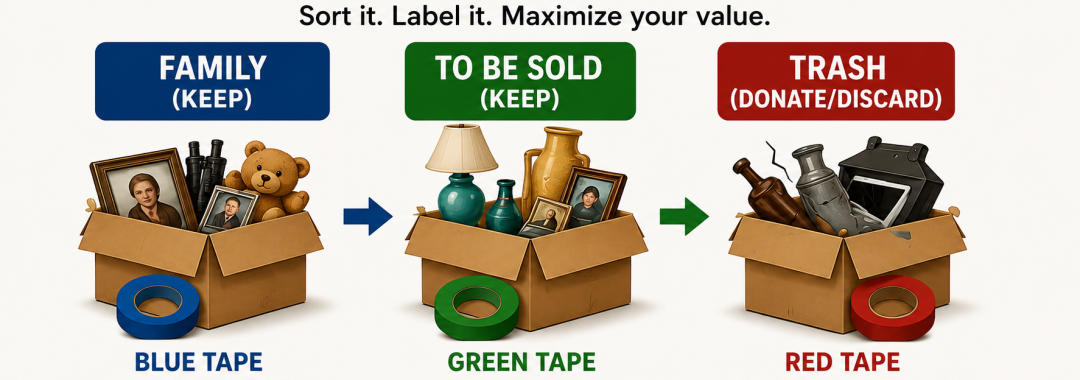
5. Use the Three‑Pile System

You don’t need to physically move items — just label them.

  • Blue Tape — Family
  • Green Tape — Sell
  • Red Tape — Trash

How to decide the color

  • If a family member wants it → Blue
  • If no one wants it → Green
  • If it’s broken, unsafe, or on the “not accepted” list → Red

All mattresses not sealed in intact plastic get red tape immediately.

Once blue‑tape items are removed and red‑tape items are trashed, you’re ready for professionals.

6. Call a company that handles BOTH the estate sale and the real estate.

When you hire a team that can do both, you gain:

  • One point of contact
  • A streamlined process
  • Better coordination between personal property and real estate
  • Often, a commission break.

This is the most efficient, least stressful way to manage an estate.

Final Thought

When you look for a solution, remember this:

Everything But the House should be Everything Including the House.

A single coordinated team protects your time, your money, and your sanity — and ensures the estate is handled with dignity from start to finish.

Ready to Market Your Property?

Contact Matthew Price for a free consultation. We’ll build a custom marketing plan around your property and your goals.

Fees Auctioneers Charge

Let’s be honest—most people have no idea what it actually costs to run an auction. They assume everything comes out of the auctioneer’s commission. That’d be nice, but in reality, those commissions alone don’t keep the lights on. So, let’s talk about what really goes into the cost of doing business as an auctioneer.

First off, auctioneering is a profession. It’s not a hobby, and it’s not free. Agreeing to the price doesn’t mean you’re getting a volunteer. That’s like asking someone to work a double shift on a hot grill and then telling them, “Thanks, but we’re not paying you.” It doesn’t work that way.

The Importance of Licensing and Transparency

Recently, someone sent me documents asking for my take on a situation. The company claimed to operate with the highest ethics—but they weren’t licensed in the states they served and weren’t part of any professional association. That’s a red flag. If you’re hiring an auctioneer, check their credentials. Licensing matters, and it doesn’t come cheap. Between a Real Estate Broker and an Auctioneer, the Auctioneer’s license is three times more in expense, and the professional must know 25+ laws inside and out.

The Truth About Rates and Competition

Most auctioneers don’t post their rates publicly. Why? Because if everyone did, it could lead to price matching—and that’s where things get tricky. Publishing rates isn’t illegal, but if auctioneers start coordinating those rates, it could violate federal law under the Sherman Antitrust Act.

Price fixing—where businesses agree to raise, lower, or stabilize prices together—is the most common violation. However, simply posting your own rates is not price fixing. It only becomes a problem if there’s an agreement among competitors to do it together.

You’ll find plenty of auctioneers online who do share their commission structures. Some use flat rates (e.g., 50% on all items, plus labor and marketing), while others use sliding scales, such as:

  • 10% for items over $10,000
  • 15% for items between $5,000 and $10,000
  • 20% for items under $5,000 (with a $50 minimum)
  • Plus labor, marketing, and other costs.

The only time it crosses the line is when multiple auctioneers in the same area agree to charge the same rates to control the market. That’s collusion—the same tactic that led to the Sotheby’s scandal in 2000.

Bottom line: If you’re a trustee, executor, or seller, focus on finding an auctioneer who is licensed, ethical, and transparent. Find someone who will get you the best results, not just the lowest rate.

Comprehensive Cost Breakdown: Live, In-Person Auction

The following figures represent realistic U.S. estimates for planning and budgeting. While actual costs vary by market, this breakdown illustrates the overhead behind the scenes.

1. Licensing & Regulatory Costs

ItemEstimated Cost
State auctioneer license$100 – $400 / year
Apprentice / firm license$100 – $300 / year
Surety bond$100 – $500 / year
Continuing education$100 – $400 / year
Background checks$50 – $100
Local business license$25 – $200 / year
Legal/accounting compliance$500 – $3,000 / year

Annual Compliance Range: $875 – $4,900+

2. Insurance

ItemEstimated Cost
General liability$500 – $2,000 / year
E&O (Errors & Omissions)$600 – $2,500 / year
Commercial auto insurance$1,200 – $3,000 / year
Workers comp$1,000+ per employee / year
Event-specific rider$150 – $500 / auction

3. Marketing & Advertising

Marketing is often the largest per-auction expense.

Print & Direct:

  • Flyers & brochures: $200 – $1,000
  • Newspaper ads: $500 – $3,000
  • Postcards/mailers: $800 – $5,000

Digital:

  • Website hosting: $200 – $600 / year
  • Online bidding platform: 2% – 5% of sales OR $500 – $2,000 / event
  • Social media ads: $300 – $2,000
  • Photography: $300 – $2,000
  • Videography/drone: $500 – $3,000

Typical per-auction marketing range:

  • Small auction: $1,000 – $3,000
  • Major equipment/real estate: $5,000 – $15,000+

4. Equipment & Personnel

Audio & Auction Gear:

  • Sound system/mixers: $1,500 – $5,000
  • Clerking software: $1,000 – $3,000
  • Laptops/tablets: $800 – $2,000 each

Personnel Costs (Per Auction):

  • Ringmen (2–4): $200 – $400 each
  • Clerks (1–2): $200 – $350 each
  • Cashier: $200 – $350
  • Traffic control: $300 – $1,000
  • Typical total labor cost per auction: $1,000 – $5,000+

5. Operational Overhead

  • Site/Setup: Tents ($500–$2,500), dumpsters ($400–$800), and signage ($300–$1,500).
  • Asset Prep: Title processing ($50–$200/vehicle), appraisals ($500–$2,500), and cleaning/detailing ($300–$2,000).
  • Office: Rent ($500–$3,000/mo), banking/merchant fees (2.5%–3.5% of sales).
  • Transportation: Truck payments ($500–$1,200/mo) and fuel costs.

What Does a Live Auction Actually Cost to Conduct?

  • Small Estate Auction: $3,000 – $10,000
  • Mid-Size Equipment Auction: $10,000 – $25,000
  • Large Farm or Commercial Auction: $25,000 – $75,000+

Many sellers believe the auctioneer “just shows up and talks.” In reality, the auction business operates with significant overhead, risk, compliance costs, and upfront marketing investment long before a single bid is ever placed.

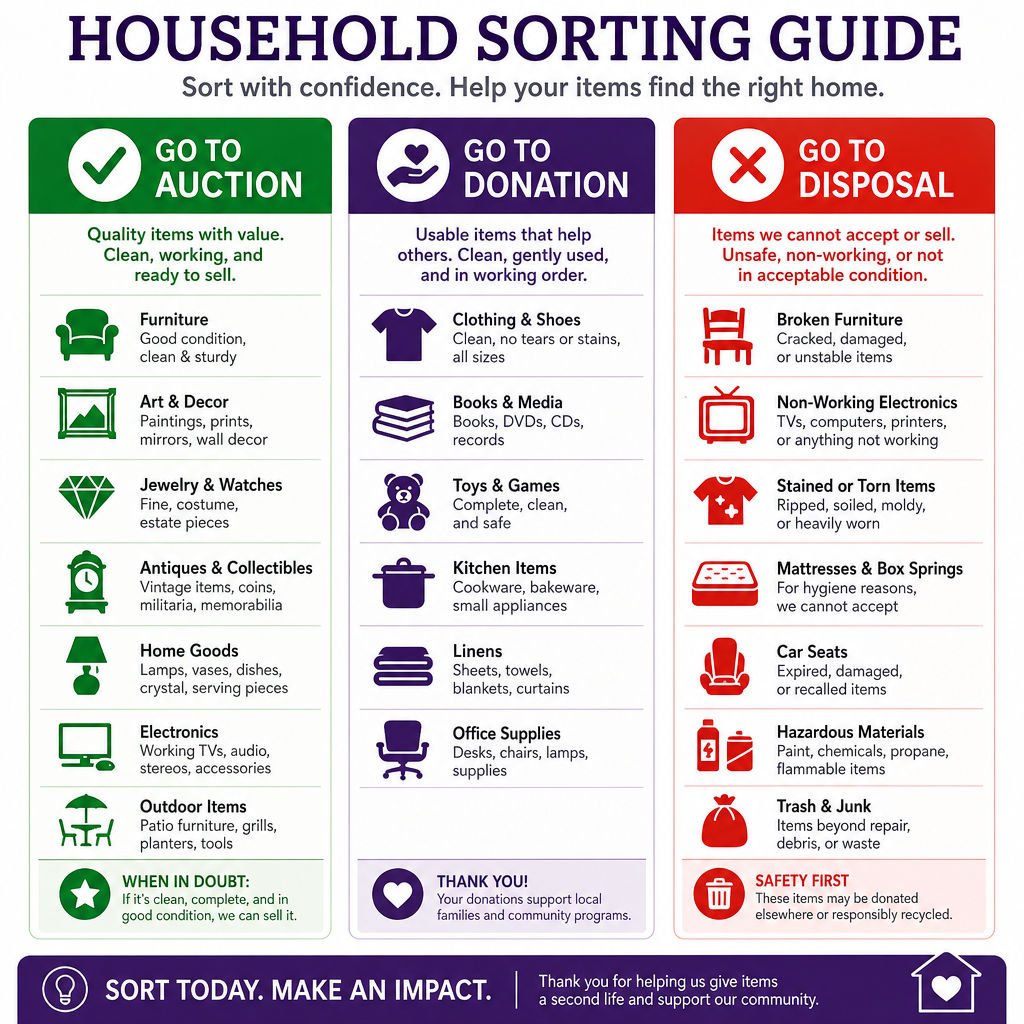
List of Items Not Accepted For Sale

(Updated and expanded to reflect common nonprofit restrictions)

Furniture & Large Household Items

  • Broken or damaged furniture — including cracked, missing parts, glued repairs.
  • Upholstered furniture that is torn, stained, mildewed, pet‑soiled, or missing cushions.
  • China cabinets & oversized furniture (too large to resell or transport).
  • Mattresses & box springs (Goodwill, Salvation Army, Habitat do NOT accept).
  • Sofa beds, recliners, sleeper sofas (mechanisms often broken; high disposal cost).
  • Large entertainment centers (obsolete and unsellable).
  • Particle‑board furniture that is swollen, peeling, or unstable.

Personal Hygiene & Medical Items

  • Personal hygiene tools — clippers, razors, needles, lancets.
  • Toiletries — shampoos, lotions, mouthwash, powders (nonprofits cannot verify safety).
  • Feminine hygiene products — tampons, pads, Depends, medicated wipes.
  • Medications & supplements — herbs, vitamins, syrups, ointments.
  • Hair tools — brushes, combs, curlers, wigs, dryers, hot rollers, curling irons.
  • Hearing aids, dentures, teeth (biohazard concerns).
  • Medical testing supplies — anything that may have contacted bodily fluids.

Clothing & Fabric Items

  • Undergarments — bras, panties, boxers, lingerie, pantyhose, socks.
  • Soiled linens, pillows, mattress pads (nonprofits cannot sanitize them).
  • Moldy or mildewed textiles of any kind.

Baby & Child Safety Items

  • Drop‑side cribs (federally banned).
  • Car seats (expiration & safety liability).
  • Strollers (unless new and certified safe).
  • High chairs with missing straps or recalls.

Food & Beverages

  • Food items of any kind (except sealed pantry donations to food banks).
  • Liquor/alcohol — only accepted if sealed in original packaging.

Financial & Personal Documents

  • Old bills, mail, medical records
  • Checkbooks, ledgers, tax papers
  • Family photos, videos, DVDs (privacy & sensitivity concerns)

Household Waste & Unsanitary Items

  • Dirty waste cans
  • Used toilet brushes
  • Used kitchen scrubbies
  • Shower curtains (unless new)
  • Soiled bath mats

Hazardous Materials

  • Fuels, oils, paints, pesticides
  • Lead, asbestos
  • Mercury items — fluorescent lamps, thermometers, thermostats, CFL bulbs
  • Chemicals or liquids — pool supplies, acids, bleaches, detergents
  • Expired or empty fire extinguishers

Automotive Items

  • Old worn‑out tires (dry rot)
  • Expired or used batteries

Adult Content

  • X‑rated magazines, posters, videos, DVDs

Electronics & Technology

  • Outdated technology — CRT monitors, towers, printers, fax machines
  • Software discs
  • Loose parts or cables
  • Older televisions — only newer flat‑screen digital models accepted
  • Cassette players, VHS players, tapes (no resale market)

Wildlife & Taxidermy

  • Bird mounts or fish mounts
  • Pronghorn antelope or bobcats without proper tags
  • Any taxidermy with damage or deterioration

Books & Printed Material

  • Encyclopedias
  • Law books
  • Magazines
  • Stacks of newspapers

Appliances

  • Dirty or uncleaned appliances
  • Refrigerators/freezers not cleaned out
  • Broken appliances of any kind

Access & Handling Requirements

  • Items stored in attics must be brought down to the main floor.
  • No broken items — must be clean, complete, and functional.
  • No cracked, glued, or missing‑part items.

Disposal Policy

If any prohibited items are included, and Matthew Price, Auctioneer & Real Estate Broker must dispose of them:

  • Seller is responsible for all disposal costs
  • Includes labor, handling, loading, hauling, dump fees
  • Costs will be deducted from sale proceeds
  • Seller reimburses all disposal expenses in full

Donation Alternatives

SPCA Needs

  • Cat litter (clumping & non‑clumping)
  • Cat food (pâté)
  • Kitten & puppy food
  • High‑quality brands: IAMS, Purina ONE, Science Diet, Blue Buffalo
  • Dog treats (training‑quality)

Emergency Food Pantries

  • Canned goods
  • Dry goods

Hygiene & Toiletries

  • New, unopened items only

Paper Shredding

  • Community shredding drives
  • County shredding services

County Recycling

  • Cardboard
  • Aluminum
  • Plastics
  • Metals (Check county website for hours & locations)

Eyeglasses

  • Lions Club
  • Walmart optical centers
  • Local eye doctors

Military Missions in Action

  • Furnishes homes for veterans returning from service
  • Accepts furniture & household items

Choosing the Best Liquidation Strategy

Deciding how to handle a lifetime of accumulated belongings is a significant responsibility that carries both financial and emotional weight. As an estate executor or representative, selecting the most suitable liquidation method is crucial for achieving a smooth process and maximizing returns. The two primary options—estate sales and auctions—operate quite differently, making it essential to understand their distinctions, benefits, and potential risks before proceeding.

High-Level Comparison

Estate sales and auctions differ in several fundamental ways. Estate sales use fixed, research-based retail prices set for each item, while auctions rely on dynamic pricing determined in real time through competitive bidding. Estate sales typically run over a 2–3 day on-site period, whereas auctions are often completed in a single day, a few hours, or within a defined online bidding window. Buyers at estate sales enjoy a relaxed, browse-and-buy retail shopping experience inside the home, in contrast to the fast-paced, competitive environment of auctions, which may be in-person, online, or hybrid. Estate sales work best for general household contents, everyday items, furniture, and tools. Auctions are ideal for high-value collections, fine art, rare antiques, and unique specialty pieces.

The core distinction lies in value realization: estate sales capture value through carefully researched tag pricing, while auctions leverage open-market competition to potentially achieve peak demand prices. It is not proper to call estate tag sales establishing fair market value due to the complexity of the pricing models. Whereas auctions establish the current fair market value through the bid process, where a buyer bids as high as they would like on the property, an estate tag sale negotiates prices lower.

How Estate Sales Work

An estate sale converts a private home into a multi-day pop-up retail store. Professional liquidators begin by sorting, researching, appraising, and staging every item throughout the property, ranging from living room furniture to kitchenware and garage tools. Once prepared, the doors open to the public for two to three days. Buyers browse at their own pace and make purchases at the marked prices, which are generally firm on the first day and then discounted progressively on following days to help clear out remaining inventory. This approach sometimes delivers full-house liquidation, typically allowing the entire process—from initial consultation to final cleanout—to wrap up within one to three weeks.

How Auctions Work

Auctions establish value through direct bidder competition and can take place via live in-person events, timed online platforms, or hybrid formats. The process involves cataloging and photographing items before presenting them to bidders, with the highest bidder winning each item or lot. An auctioneer calls bids in real time during live events, or an online platform handles timed bidding. This format creates urgency and momentum that can drive up prices for sought-after items. As a result, auctions concentrate buyer interest into a decisive event, making them particularly effective for high-demand assets where competitive bidding can unlock maximum market value. A key advantage is that auction companies typically sell the property down to the bare walls, removing nearly everything and eliminating additional hauling, disposal, or storage costs for the seller.

When an Estate Sale Is the Better Choice

Estate sales are purpose-built for whole-home liquidation, especially when the goal is to systematically clear out the complete contents of a property. They excel at monetizing everyday value by pricing and selling nearly every minor item individually—such as linens, kitchen utensils, cleaning supplies, garden tools, and decor—which auction houses might otherwise skip or bundle into bulk lots. The on-site format is particularly advantageous for bulky items like furniture and appliances, as buyers can inspect them in context and typically arrive prepared with trucks and labor for removal. Estate sales also draw a broad local audience, including casual shoppers, neighbors, dealers, collectors, and bargain hunters, providing wide exposure across all types of inventory. Additionally, they offer predictable timelines that align well with real estate closing deadlines or probate schedules.

However, estate tag sales carry notable risks. If items that have a viable market do not sell during the sale period, they remain behind, potentially leaving the seller responsible for further removal, donation, or disposal efforts and associated costs.

When an Auction Makes More Sense

Auctions provide clear advantages when dealing with targeted, rare, or high-value items where fixed pricing might not capture full potential. They are especially effective for fine art, rare coins, luxury jewelry, firearms, or classic cars, as competitive bidding among passionate collectors can push final prices well beyond initial estimates. Online auction platforms extend global exposure to specialized buyers rather than relying solely on local foot traffic. Auctions also deliver a clear paper trail and high conversion rates through definitive event dates and transparent transaction records.

The Combined Hybrid Strategy

In many cases, the most profitable approach combines both methods. High-value art, rare coins, or standout collectibles can be directed to specialty auctions to reach targeted global buyers. The remaining household contents—furniture, kitchen supplies, everyday decor, tools, and clothing—can then be sold through an on-site estate sale. This dual strategy ensures each asset type is matched with the selling environment optimized for its highest return.

Costs, Fees, and Buyer’s Premiums

Estate sale companies generally charge a seller’s commission of 30% to 40% of total gross sales. This rate is typically all-inclusive, covering setup, labor, appraisal, marketing, staffing, and post-sale cleanup, with the company’s incentives fully aligned to overall performance.

Auction houses usually apply a lower seller’s commission, often between 15% and 25%. To manage costs like professional photography, marketing, cataloging, and overhead, they commonly add a buyer’s premium—an additional percentage paid by the winning bidder on top of the hammer price. This structure benefits sellers by shifting much of the operational burden to buyers, resulting in lower commission rates and a larger share of the base sale price retained.

Decision-Making Framework

To help determine the best path, consider the nature of the assets being liquidated. If the estate consists of an entire household with mixed inventory and a fast cleanout is needed, an estate sale is typically the right choice—provided you accept the risk that unsold items with potential market value may remain. For high-value or rare items such as fine art, coins, or niche collections, an auction generally makes more sense, especially when you want everything sold down to the bare walls to avoid lingering removal costs. When the estate includes both standout specialty pieces and a full house of general contents, a combined hybrid approach often delivers the strongest results.

Evaluating the inventory early with a qualified liquidation professional provides an honest assessment and guides you toward the strategy that maximizes financial return while minimizing stress.

In the case of a hoarder home, an auction is likely the best solution. Many estate sale companies do not handle the real estate, whereas many auctioneers who are dual licensed do, either by auction or traditional real estate.