September Launch of Online Auctioneer Licensing Program Through Central Carolina Community College

The Auction Academy of North Carolina is proud to announce the launch of its fully online Auctioneer Licensing Course, beginning September 2026 in partnership with Central Carolina Community College (CCCC). This program offers aspiring auctioneers across the state a flexible, accessible pathway into one of North Carolina’s most dynamic professions.

We are in the final approval stages for September 21 launch.

Designed for working adults, entrepreneurs, and anyone interested in the auction industry, the course provides state‑approved pre‑licensing education at an affordable tuition of $190.50. Upon successful completion, students will be fully prepared to sit for the North Carolina Auctioneer Licensing Board (NCALB) exam and begin their professional journey.

A Modern, Accessible Path Into the Auction Profession

The September program marks a major step forward in making auction education more accessible statewide. Through CCCC’s online learning platform, students can explore the world of auctioneering from anywhere in North Carolina while receiving structured instruction from experienced, licensed auction professionals.

The curriculum covers:

  • Auction law and compliance
  • Bid‑calling fundamentals and voice development
  • Auction marketing and promotion
  • Contracts, settlements, and fiduciary responsibilities
  • Online auction operations and technology
  • Professional standards and ethics

This comprehensive approach ensures graduates not only meet state requirements but also enter the industry with confidence, competence, and a clear understanding of modern auction practices.

Ready for the Licensing Board — and Beyond

Graduates of the September cohort will be fully prepared for the NCALB licensing exam, meeting all educational prerequisites required by the state.

But Auction Academy’s commitment doesn’t end at graduation.

Post‑Licensing Support Includes:

  • One‑on‑one coaching with seasoned auctioneers
  • Group meet‑ups for networking and continued skill development
  • Ongoing mentorship for new licensees entering the field
  • Community support through the Academy’s statewide network

This ensures new auctioneers have the guidance, confidence, and professional support needed to thrive in their first year of business.

Interested? Fill out this official form, and get the link and dates mailed directly to your inbox

👉 Auction Licensing Interest Form

Submitting the form ensures early notification when registration opens through Central Carolina Community College and provides access to program updates, schedules, and onboarding details.

About Auction Academy of North Carolina

The Auction Academy of NC is a modern, student‑focused training institution dedicated to raising the standard of auction education statewide. Led by licensed auctioneer and educator Matthew Price, the Academy provides accessible, relevant, and practical instruction designed for today’s marketplace. Its mission is to equip new auctioneers with the skills, ethics, and confidence needed to serve clients with professionalism and integrity.

Media Contact

Auction Academy of North Carolina Email: admin@auctionacademync.com Website: https://auctionacademync.com

I Don’t Offer Buyer’s Agent Compensation — And Why That’s Actually Good for You

If you’ve shopped for a home or bid on a property lately, you’ve probably noticed something has shifted in real estate. For decades, it was standard practice for the seller — through the listing broker — to pay the commission for the buyer’s agent too. It felt free. It felt normal. Almost nobody questioned it.

I do question it. And after fourteen years of standing on both sides of the auction block and the closing table, I’ve made a deliberate business decision not to offer buyer’s agent compensation on my listings. I want to explain why — not as a marketing angle, but as a matter of principle rooted in something every licensed professional is supposed to take seriously — fiduciary duty.

Start With a Simple Question

Would you ever accept a settlement offer from a lawsuit where the opposing party’s attorney was being paid by your side?

Nobody would agree to that. It doesn’t matter how good the attorney is, how well-intentioned they are, or how many disclosures get signed. The moment your adversary’s counsel is compensated by the person across the table from them, the integrity of the arrangement is compromised. We don’t need a law degree to sense that something is wrong with it — it’s wrong on its face.

Real estate works the same way, whether the industry wants to admit it or not.

The Buyer’s Agent Is Supposed to Work for the Buyer

A buyer’s agent owes a fiduciary duty to the buyer. Loyalty. Full disclosure. Good faith negotiation. Advocacy for the buyer’s best price and best terms — even when that means pushing hard against the seller.

The seller’s agent — in my case, as the auctioneer and listing broker — owes that exact same duty, but to the seller. My job is to get the best price and best terms for the person who hired me. That’s not a conflict. That’s the whole point of representation.

Now ask yourself what happens when the seller’s side is the one writing the check to the buyer’s agent.

Suddenly the person whose job is to advocate against my client is being paid by my client. The buyer’s agent’s paycheck is now tied — directly or indirectly — to the outcome the seller’s side controls. That is precisely the arrangement we’d never tolerate from opposing attorneys, and for the same reason — it introduces a financial incentive that runs against undivided loyalty.

It doesn’t matter whether it’s dressed up as “cooperating compensation,” baked into a commission split, or offered as a courtesy on the listing. The structure is the same. One side is financially beholden, at least in part, to the party it’s supposed to be negotiating against.

Why This Matters Even More at Auction

In a traditional negotiated sale, this conflict is troubling. At auction, it’s magnified.

The entire premise of an auction is genuine price discovery — letting real, motivated buyers compete openly to establish true market value, without artificial floors, steering, or hidden incentives distorting the outcome. When a buyer’s agent’s compensation is subsidized by the seller’s side, you introduce a variable that has nothing to do with what the property is actually worth and everything to do with how commissions are structured behind the scenes.

Did that agent bring their buyer to my auction because it was the best fit for their client — or because the compensation offered was more attractive than at the property down the road? Did that agent negotiate as hard as they could for their buyer, or temper their advocacy because the check was coming from the other side of the transaction? I can’t answer that for other auctioneers or other listings. I can control it for mine.

What I Do Instead

I don’t offer buyer’s agent compensation because I believe fiduciary duty should mean something — not just to me, but to every professional at the table. If a buyer chooses to work with their own agent, that’s entirely their right, and I’ll cooperate with that agent professionally and transparently. But that agent’s compensation is a conversation between the buyer and their own representative, negotiated directly, the same way you’d negotiate with your own attorney.

That keeps incentives clean. It keeps my duty to my seller intact. It keeps the buyer’s agent’s duty to their buyer intact. And it keeps the price discovery at auction honest — which, frankly, is the entire reason someone hires an auctioneer in the first place.

The Bottom Line

You wouldn’t want your attorney paid by the person suing you. You shouldn’t want your real estate representation paid by the person on the other side of your transaction, either. It’s not about who has to write the check. It’s about who that check makes you beholden to.

I built my practice around undivided loyalty — to my sellers, and to the integrity of the process itself. That’s not always the popular position in an industry that’s grown comfortable with the old way of doing things. But it’s the right one.

Things YOU can do to reduce Estate Sale Costs

Many times we’re brought in to handle an estate sale — sometimes through an Estate Tag Sale, sometimes through Auction. The principles are the same: the more work that’s done upfront, the fewer costs you’ll face, especially if you choose the tag‑sale option. A little preparation can dramatically reduce expenses and increase your final margins.

Hiring a professional estate sale company can save you a tremendous amount of time and effort. But that convenience does come with a cost. You’ll pay a portion of the proceeds as a commission sometimws 40% to 60%, and depending on the items, 100%. For many families — especially when the items aren’t theirs or they’re dealing with the loss of a loved one — that fee is worth it. It allows them to focus on the emotional and logistical challenges of selling a home, relocating, or settling an estate while the professionals handle the heavy lifting.

THE MAGIC LIST

More often than not, a traditional real estate broker is focused on one thing: selling the house. And to do that quickly, many will recommend clearing everything out — even if that means tossing valuable personal property.

1. Do NOT go to a real estate broker first.

That is a disservice to you, and it undermines their fiduciary duty.

Why?

You’re trusting your broker to maximize the value of the real estate. Many brokers overlook the value of personal property entirely. Thousands of dollars in items can be thrown away simply to speed up the listing. We have seen anywhere from $4,000 to $60,000 of valued goods in a house simply take a ride to the landfill.

That money could help settle probate expenses, cover closing costs, or increase the estate’s final distribution.

2. Do NOT go to an estate tag sale company first either.

Before you hire anyone, you need to understand exactly what they do.

Some companies only sell the good items and leave the junk behind. Some remove trash but don’t handle donations. Some sell everything but leave the house in disarray.

You want a company that can:

  • Remove trash
  • Sell quality items
  • Coordinate donations for leftovers
  • Leave the home clean, vacuumed, and ready for the real estate broker

Why?

You’re trusting your personal property to a company that should maximize your return. The real estate often brings in more money than the personal property — but the personal property can support the estate by covering closing costs, probate fees, and other expenses that appear late in the process.

3. Prepare early — especially when a loved one is terminal.

Families often hope for recovery, and sometimes that hope delays necessary preparation. But once doctors say a condition is terminal, it’s time to begin gathering what you know you’ll need.

Find these documents immediately:

  • Wills
  • Insurance policies
  • IRA and retirement documents
  • Deeds
  • Titles
  • Banking information
  • Safe deposit box keys or access codes

Go through every box. Important documents often end up at the bottom, and families accidentally throw them out without realizing it.

4. Do NOT wait months to enter the property.

As soon as possible, remove:

  • Food
  • Trash
  • Medications
  • Guns
  • Controlled substances
  • Anything that can rot, mold, or attract pests

Why this matters

When families wait months, several problems occur:

  • Trash begins to rot
  • Doors get forced open
  • Squatters live in the home
  • Houses get ransacked
  • Weapons disappear
  • Criminals target the home

Criminals read obituaries. They know how to find vacant homes. Released felons are given a tablet or a Chromebook and a cell phone, and can get emailed alerts like everyone else. A monitored, visited property is far less likely to be targeted.

Selling quickly prevents:

  • Criminal activity
  • Overgrowth and property deterioration
  • Accumulated carrying costs (taxes, HOA, utilities)
  • Indoor maintenance issues (paint, pests, moisture)
  • Required repairs under traditional real estate contracts

Selling at auction avoids many repair requirements entirely, whereas the Traditional Realtor will want to re-do kitchens, bathrooms, and other high dollar renovations that commonly do not get a return on the renovation cost. Don’t fall for the “If you spend $6,000 you will get $8,000 in returns,” the NAR, Zillow, and Redfin data does not show that you ever get that back, if at all.

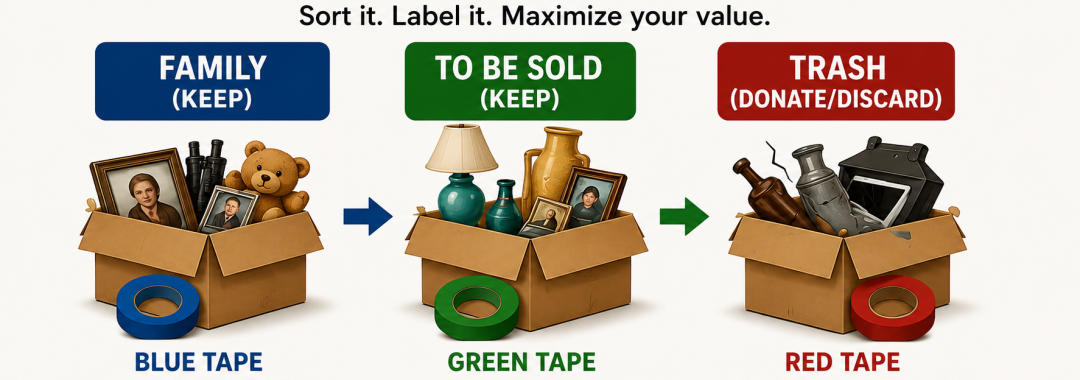
5. Use the Three‑Pile System

You don’t need to physically move items — just label them.

  • Blue Tape — Family
  • Green Tape — Sell
  • Red Tape — Trash

How to decide the color

  • If a family member wants it → Blue
  • If no one wants it → Green
  • If it’s broken, unsafe, or on the “not accepted” list → Red

All mattresses not sealed in intact plastic get red tape immediately.

Once blue‑tape items are removed and red‑tape items are trashed, you’re ready for professionals.

6. Call a company that handles BOTH the estate sale and the real estate.

When you hire a team that can do both, you gain:

  • One point of contact
  • A streamlined process
  • Better coordination between personal property and real estate
  • Often, a commission break.

This is the most efficient, least stressful way to manage an estate.

Final Thought

When you look for a solution, remember this:

Everything But the House should be Everything Including the House.

A single coordinated team protects your time, your money, and your sanity — and ensures the estate is handled with dignity from start to finish.

Ready to Market Your Property?

Contact Matthew Price for a free consultation. We’ll build a custom marketing plan around your property and your goals.