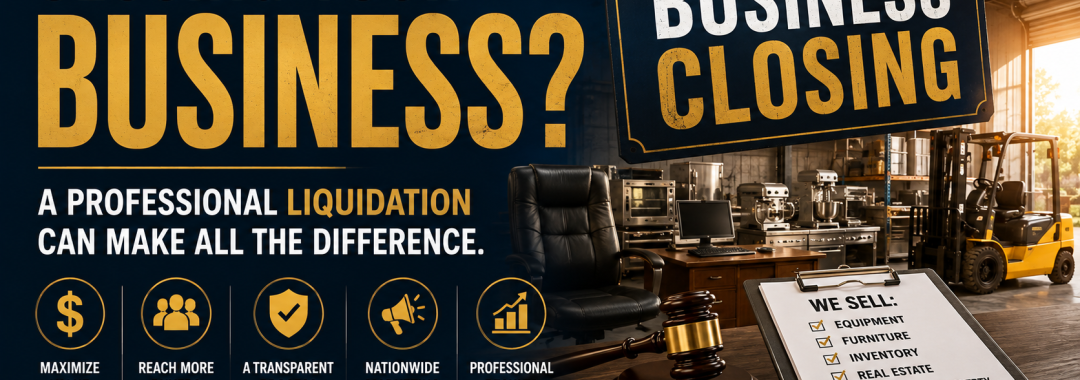
Few business owners begin their journey thinking about how it will eventually end. Whether you’re retiring after decades of hard work, moving into a new venture, or simply deciding it is time to close the doors, every business eventually reaches a point where its assets must be converted into cash. That process is known as liquidation, but successful liquidation is far more than simply selling equipment. It is the careful marketing of an entire business’s assets to produce the highest possible return while meeting legal and financial obligations.
Many owners assume liquidation means putting a few items on Facebook Marketplace, eBay, or another online marketplace and waiting for buyers to appear. While that approach may work for a lawn mower or an old desk, it rarely produces the best results for an entire business. Commercial equipment, machinery, vehicles, inventory, furniture, intellectual property, and even real estate each appeal to different types of buyers. Reaching those buyers requires a coordinated marketing effort, not dozens or hundreds of individual listings scattered across the Internet.
The first step in any business liquidation is understanding exactly what the business owns. Most people immediately think of equipment and inventory, but those are only part of the equation. Office furniture, computers, vehicles, trailers, shelving, manufacturing equipment, tools, and real estate all have value, but so do less obvious assets. Security deposits, refundable insurance premiums, customer deposits, accounts receivable, and prepaid services can often be converted into cash as well. Before any sale begins, these assets should be identified, documented, and evaluated so that nothing of value is overlooked.
Just as important are the intangible assets that many owners forget they possess. A recognizable business name, established website, customer database, telephone numbers, trademarks, copyrights, patents, supplier agreements, and favorable lease terms may all carry significant value. Competitors entering your market may have little interest in your desks or filing cabinets, but they may be willing to pay a premium for years of customer relationships or a respected brand name. In today’s economy, intangible assets frequently represent a substantial portion of a company’s overall value, and they deserve the same level of marketing attention as any physical asset.
This is where many business owners unintentionally leave money on the table. Liquidation is often viewed as simply disposing of unwanted property, but professional auctioneers understand that liquidation is actually a marketing business. The objective is not merely to sell; it is to create competition among qualified buyers. Every additional bidder increases the likelihood of achieving true market value. Modern auction marketing combines targeted email campaigns, industry databases, social media advertising, search engine marketing, direct outreach to equipment dealers and investors, and national advertising to expose assets to buyers who are actively searching for them. Instead of hoping someone local happens to need a particular piece of equipment, a professionally marketed auction places that equipment in front of buyers across the country—and sometimes around the world.
Many owners underestimate the amount of time required to sell an entire business one item at a time. Every listing requires photographs, descriptions, pricing, communication with prospective buyers, scheduling inspections, negotiating terms, collecting payment, and coordinating pickup or shipping. Multiply that process by several hundred assets, and what appears to be a cost-saving measure quickly becomes a full-time job. Meanwhile, the business continues to incur expenses. Insurance premiums continue, utilities remain connected, rent or mortgage payments continue, property taxes accumulate, and valuable management time is consumed by selling instead of planning the next chapter. A professionally managed auction compresses months of individual sales into a coordinated marketing campaign followed by a defined sale period, allowing the business to move forward more efficiently.
One of the most common questions owners ask is, “What is my equipment worth?” Unfortunately, the answer is almost never what they originally paid for it. Neither purchase price nor replacement cost determines fair market value. Fair market value is simply the price that a willing buyer is prepared to pay a willing seller after the asset has been exposed to the open marketplace. Advertised asking prices on websites often bear little resemblance to actual selling prices. Insurance values are designed to replace equipment, not measure resale value. Appraisals provide useful guidance, but they still represent an opinion. The marketplace ultimately decides value, and nothing demonstrates current market value more effectively than competitive bidding among qualified buyers.
Business owners also have important legal responsibilities throughout the liquidation process. If the company has outstanding debts, owners cannot simply transfer valuable equipment to friends or relatives for a fraction of its value or hide assets from creditors. Depending upon the financial condition of the business, owners, officers, managers, and directors may owe fiduciary duties to creditors as well as shareholders. Assets should be marketed openly and sold in a transparent manner that demonstrates every reasonable effort was made to obtain fair market value. Proper documentation and competitive marketing not only maximize returns but also help protect owners from future claims that assets were improperly disposed of.
Some assets require additional attention before they can be sold. Equipment financed through banks or leasing companies may be subject to liens or lease agreements that limit an owner’s ability to sell without the lender’s approval. Vehicles often carry title liens, and machinery may have Uniform Commercial Code filings attached to it. Before liquidation begins, these interests should be identified so lenders, attorneys, accountants, and auctioneers can coordinate an orderly disposition that satisfies all legal requirements. Resolving these issues before the sale prevents delays and gives buyers confidence that clear title can be transferred.
While owners naturally focus on physical assets, outstanding accounts receivable deserve equal attention. Money owed to the business becomes increasingly difficult to collect once operations cease. Customers may delay payment or assume no one is monitoring collections. Collecting receivables before closing often produces the greatest recovery, although businesses may also consider selling receivables to a factoring company when immediate cash flow is more important than collecting the full balance over time.
Another frequently overlooked opportunity involves recovering money that has already been paid. Workers’ compensation premiums, liability insurance, utility deposits, prepaid service contracts, and other refundable expenses can often generate additional cash during the wind-down process. Individually these amounts may seem small, but together they can significantly improve the final financial outcome.
For business owners who lack the time, experience, or desire to manage every aspect of liquidation themselves, hiring a professional auctioneer can dramatically simplify the process. An experienced auctioneer develops the marketing strategy, prepares the inventory, photographs and catalogs the assets, coordinates inspections, manages bidder registration, conducts the auction, collects payment, supervises asset removal, and provides a complete accounting after the sale. Instead of managing hundreds of individual transactions, the owner works with one experienced professional whose responsibility is to maximize exposure and produce competitive bidding.
Matthew Price, Auctioneer & Real Estate Broker specializes in helping business owners transition through this important stage. Whether the business consists of a restaurant, retail store, manufacturing facility, construction company, automotive shop, office complex, or commercial real estate portfolio, every liquidation begins with the same objective: exposing the assets to the largest possible audience of qualified buyers. Through extensive marketing, nationwide buyer outreach, and transparent auction methods, assets receive the competitive exposure necessary to achieve current market value rather than simply accepting the first available offer.
Closing a business represents the end of one chapter, but it should not mean leaving money behind. A properly planned liquidation transforms years of investment into capital that can satisfy creditors, meet legal obligations, and provide owners with the strongest possible financial position for whatever comes next. With professional guidance, strategic marketing, and competitive bidding, liquidation becomes more than simply selling assets—it becomes the final successful transaction of the business itself.