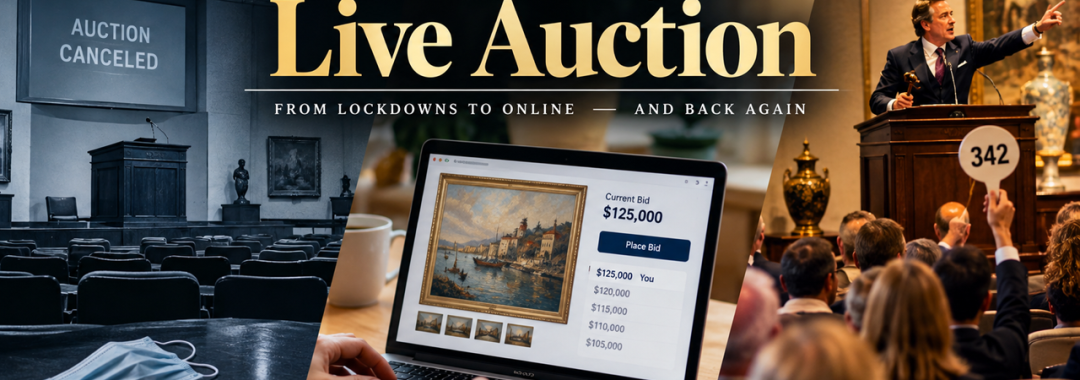
For a while, it looked as though the auction hall might become a relic.
The pandemic did not merely close auction houses. It appeared to challenge the very premise on which the traditional auction had been built: that buyers and sellers needed to occupy the same room, at the same time, to create a market.
In March 2020, as governments imposed lockdowns across the United States and Europe, auction halls emptied almost overnight. New York held its last live auction on March 16. London followed three days later. Hundreds of sales were canceled or postponed. Auctioneers, who had spent generations perfecting the art of reading a room, suddenly had no room to read.
The alternative was already sitting on the internet.
Online auctions had existed for years, but before the pandemic they were often regarded as a useful supplement to the traditional sale rather than its replacement. The coronavirus changed that calculation almost instantly. Auction houses moved catalogs online, expanded digital bidding and experimented with livestreaming. Buyers who could no longer walk through a gallery or sit in an auction hall learned to bid from their kitchens, offices and living rooms.
The transformation was dramatic. A study by Christine Bourron of Pi-eX, published in Arts in 2021, found that online-only auctions accounted for about 25 percent of sales at Christie’s, Sotheby’s and Phillips at the end of 2019. By the end of 2020, that figure had risen to 66 percent.
But the numbers also revealed something unexpected.
The online revolution did not eliminate the auction hall. It exposed what the hall had been doing all along.
During the second quarter of 2020, combined revenue at Christie’s, Sotheby’s and Phillips fell 79 percent from the previous year, from $4.4 billion to about $900 million. Online-only sales grew enormously, reaching more than $1 billion in 2020, but they did not make up for the loss of live-auction revenue.
As restrictions eased, auction houses began bringing back the auctioneer.
The first attempts were cautious. Halls reopened without audiences. Auctioneers stood at podiums while bidders appeared on screens and telephone lines. The result was a strange hybrid: a live auction without a physical crowd.
Yet it worked.
By the end of July 2020, the rolling 12-month revenue of the three major houses had recovered from a pandemic low of $5.2 billion to $6.4 billion. Sotheby’s demonstrated the continued power of the live format with hybrid sales that generated tens of millions of dollars.
By 2021, the major auction houses were increasingly returning to live sales whenever circumstances permitted. Online auctions remained important, but they were increasingly treated as another instrument in the auctioneer’s toolbox rather than the future that would replace the old one.
That distinction matters because the pandemic taught the auction business something more complicated than “online is better.”
Online is different.
The internet removes geography. It allows an auctioneer in one state to reach bidders in another country. It permits buyers to study photographs and descriptions at their own pace. It can extend a sale for days instead of hours and allows someone who would never drive across town for an auction to participate from a phone.
But an auction is not merely a mechanism for transferring ownership.
It is also theater.
There is a peculiar psychology to sitting in a room while another person raises a bidder’s paddle. A person who came intending to spend $200 may find himself bidding $300, then $400, because someone across the room refuses to stop. The auctioneer recognizes the hesitation, pauses for a fraction of a second and asks for another bid.
Online platforms can reproduce some of that competition. They cannot perfectly reproduce the physical experience.
The difference became especially apparent when people were allowed to gather again.
The pandemic had created a population accustomed to isolation, screens and remote transactions. It also created a population that discovered how much it missed being around other people.
That may help explain one of the more curious developments of the post-pandemic auction economy – the emergence of new physical auction houses.
In August 2026, Ryan Piccirillo opened Granite Union Auction Company in Franklin, N.H., in a former 1917 church. Piccirillo had operated online after the pandemic, including auctions through Instagram Live, but eventually decided to establish a physical auction house.
At the company’s first live event, more than 40 people attended and more than 200 lots were sold.
For Piccirillo, the point was not simply to move merchandise.
It was to create an experience.
That sentiment is echoed in auction communities far beyond New Hampshire. Buyers describe live auctions in terms that have little to do with transaction costs: the people they meet, the jokes made by the auctioneer, the anticipation before the bidding begins and the satisfaction of discovering something they did not know they wanted.
One longtime auctiongoer interviewed after Granite Union’s opening recalled that before the pandemic it was possible to attend 10 auctions in a single day. After COVID, he had scarcely encountered another auction house.
His reaction to the reopening was not simply that there was somewhere new to buy things.
There was somewhere to go.
That distinction is important because the return of live auctions is not a rejection of the technology that emerged during the pandemic. In many ways, the opposite is true.
The strongest auction houses increasingly combine the two.
A bidder may preview a catalog online, examine dozens of photographs, place an absentee bid and then attend the auction in person. Another bidder may participate from 500 miles away. The online bidder’s maximum bid can become the opening bid in the room, while the auctioneer continues the competition among people standing in front of him.
This hybrid model is now appearing in auction houses across the country.
In North Carolina, for example, auction companies are conducting live sales that incorporate online absentee bidding. In some cases, the online bidding closes shortly before the physical auction begins, with the highest online bid transferred into the live auction as the starting point for the auctioneer.
The technology has not killed the auction house.
It has made the room bigger.
The same phenomenon can be seen in estate auctions, antiques, collectibles and other categories where physical inspection and social interaction remain important. Auction houses that once depended almost entirely on people driving to a sale can now market individual lots to thousands of potential bidders before the doors open.
That has changed the job of the auctioneer.
The auctioneer is no longer simply the person standing at the front of the room calling numbers. The modern auctioneer increasingly has to understand photography, search engines, social media, digital catalogs, online bidder registration, shipping, data and customer communication.
The pandemic accelerated that transformation by years.
It also changed what buyers expect.
After spending several years buying everything from furniture to automobiles through a screen, consumers are less tolerant of poor photographs, vague descriptions or confusing terms. Online auction platforms have forced traditional auctioneers to become better marketers and better communicators.
The result is an unusual marriage of old and new.
The room provides the energy. The internet provides the reach.
The auctioneer provides the human element connecting the two.
There is also an economic reason that live auctions continue to survive. A physical auction can create urgency in a way that a prolonged online sale sometimes cannot. A bidder sitting in a room watches an item move toward a conclusion in real time. Every competing bid is visible. The end is unmistakable.
At the same time, online auctions can be less expensive to conduct and can attract buyers who would never attend a live sale. For some sellers and some categories of merchandise, an online-only auction may produce a better economic result.
The lesson, therefore, is not that live auctions are superior to online auctions.
It is that neither format has proved capable of replacing the other.
The larger auction market is now demonstrating that reality at the highest levels. According to the Art Basel and UBS Art Market Report, public auction sales rose in 2025 after two years of contraction. At Christie’s, Sotheby’s and Phillips, the recovery was driven overwhelmingly by live auctions. An analysis by Pi-eX found that live-auction revenue at those three houses increased sharply during the second half of 2025, while online-only revenue grew only modestly.
Then came 2026.
The three houses reported first-half sales of about $6.8 billion, their strongest first half since 2022. Online-only auctions were recovering as well, but the largest gains were once again coming from live sales.
That is hardly evidence of a technology failure.
It is evidence that the technology found its proper place.
COVID forced the auction industry to answer a question it had avoided for years: What exactly is an auction?
If the answer is merely “a way to sell something to the highest bidder,” then an online platform is perfectly adequate.
But if an auction is also a gathering, a spectacle, a social event, a place to discover objects and people, and a contest whose drama unfolds second by second, then the physical auction room remains difficult to replace.
The resurgence of smaller auction houses may be the clearest indication of where the industry is headed.
Opening a physical auction house requires money, space, insurance, staffing and inventory. An online-only operation can begin with considerably less. Yet entrepreneurs are once again taking on the expense of physical locations, not because the internet disappeared, but because the internet did not eliminate the demand for a place where people can gather.
The new auction house may look very different from the one that existed before 2020.
It may not hold every auction in person. It may not print catalogs. It may not require every bidder to be physically present. Its merchandise may be marketed weeks in advance through digital platforms and social media.
But on auction day, the auctioneer may still walk into a room, look across a crowd and ask for another bid.
That may be the most enduring lesson of the pandemic.
Technology changed the auction business because it proved that the auction did not need a room.
The years since have demonstrated something equally important: sometimes, people still want the room.
The auction industry did not choose between live and online.
It kept both.
And as new auction houses open their doors, the old-fashioned auctioneer’s chant is beginning to sound less like an echo from the past than a signal that the auction room, after all, was never quite ready to disappear.