By Matthew Price, Auctioneer and Real Estate Broker
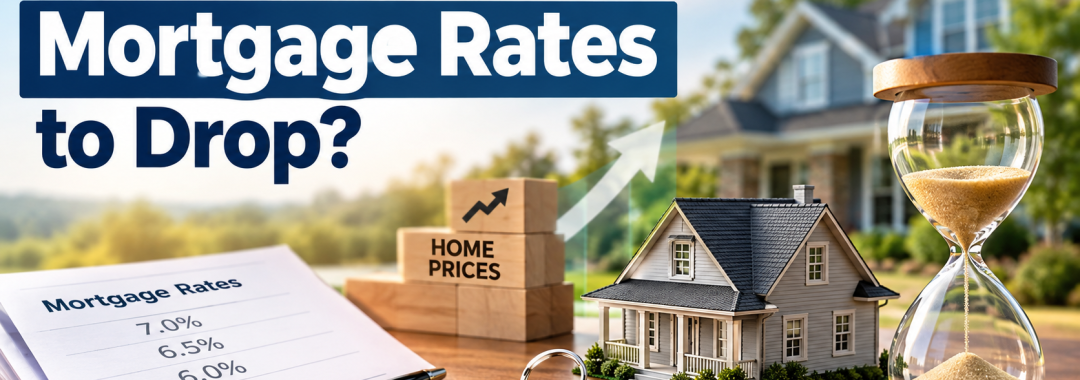
For the past several years, many prospective homebuyers have been waiting for one thing: lower mortgage interest rates.
The reasoning is understandable. Nobody wants to commit to a 30-year mortgage at a higher interest rate when rates might come down in the future. The idea of waiting for a better rate seems financially responsible.
But there is a problem with that strategy: While you are waiting for interest rates to fall, the price of the home you want to buy may continue to rise. And when rates finally do come down, you may discover that the savings on your mortgage payment are offset—or even overwhelmed—by the increased price of the home.
You could end up paying more for the same house while believing you are getting a better deal.
The question worth asking is this: Did waiting actually save you money, or did it simply change the way you paid for the house?
The Cost of Waiting
According to the housing market figures referenced in this discussion, home prices were approximately 1.6% higher than the previous year.
While a 1.6% increase may not sound significant, the effect can be substantial when applied to a $400,000 home. A 1.6% increase would add $6,400 to the purchase price.
And that is before accounting for the additional financing costs associated with borrowing more money.
Imagine you find a home priced at $400,000 today, with a 7% mortgage interest rate. You decide to wait because you believe rates will eventually fall to 6%.
A year later, rates do fall to 6%. However, the home is now worth $416,000 because prices have increased by 4%.
Assuming a 30-year fixed-rate mortgage with 20% down, here is how the numbers compare:
| Buy Today | Wait One Year | |
|---|---|---|
| Home price | $400,000 | $416,000 |
| Down payment | $80,000 | $83,200 |
| Loan amount | $320,000 | $332,800 |
| Interest rate | 7% | 6% |
| Monthly principal and interest | $2,129 | $1,996 |
| Monthly payment savings | — | $133 |
In this hypothetical example, waiting produces a lower monthly mortgage payment. The buyer saves approximately $133 per month.
However, the buyer must also come up with an additional $3,200 for the down payment and borrow $12,800 more.
The lower interest rate helps, but the higher purchase price has its own financial consequences.
And the buyer has spent an additional year without owning the property.
This is not a prediction of future home prices or interest rates. It is an illustration of the trade-offs that can occur when buyers delay a purchase.
A lower interest rate does not automatically mean a lower overall cost of homeownership.
The Banking Lesson: What Is Your Money Really Earning?
There is another way to understand the cost of waiting, and it has less to do with real estate and more to do with how we manage our money.
Think about banking and retirement savings.
Many people prefer to keep their money in a readily accessible savings account rather than place it in an investment that carries greater risk. Others may prioritize the convenience of having cash available instead of pursuing higher potential returns.
That decision can be perfectly reasonable. Emergency savings, for example, should generally be accessible when you need them.
But there is a financial trade-off that deserves attention.
Convenience and perceived safety can come at the expense of long-term growth.
Imagine you have $100,000 sitting in an account earning 2% annually. At the end of the year, you have earned $2,000 in interest.
That sounds good until you consider inflation.
If inflation is running at 2.7%, the purchasing power of that money has declined by approximately 0.7% over the year, before taxes.
Your account balance increased, but your money can buy less than it could a year earlier.
You made money on paper, but you lost ground in real terms.
Now, imagine an investment that generates a 12% annual return. Such a return is not guaranteed, and investments with greater growth potential also carry greater risk. An IRA or 401(k) is not automatically a 12% investment, either. Its performance depends on how the money is invested.
Nevertheless, the comparison illustrates an important principle: The return you receive must be evaluated against inflation and the opportunities you give up by keeping your money in a lower-yielding account.
If you earn 2% while inflation is 2.7%, your real return is negative.
Even if your money earns 1.6% interest, you are not necessarily gaining as much purchasing power as the interest statement might suggest.
The same principle applies to real estate.
Some buyers are waiting for mortgage rates to fall because they want the comfort of a lower monthly payment. That is understandable. But while they wait, home prices may continue to rise.
Just as money sitting in a low-interest account can lose purchasing power to inflation, money held on the sidelines while home prices increase may lose purchasing power in the housing market.
And there is a critical difference: A mortgage rate can potentially be changed through refinancing. But the opportunity to buy a particular home at yesterday’s price may be gone forever.
Of course, refinancing isn’t free, and lower rates are not guaranteed. Buyers should never assume that refinancing will automatically be available or financially beneficial.
The point is to evaluate the entire financial picture rather than focus on a single number.
You Can Adjust a Mortgage. You Can’t Rewind the Market.
One of the most important factors buyers should consider is the difference between a cost that can potentially be changed and a purchase price that has already been established.
If you purchase a home today and mortgage rates decline in the future, you may have an opportunity to refinance, provided that the numbers make sense and you qualify.
The interest rate on your existing mortgage may be reduced.
The price you paid for the home, however, remains the price you paid.
If comparable homes increase in value after you decide to wait, you cannot go back and purchase that same property at yesterday’s price.
This creates a potential double disadvantage for buyers who delay:
First, they miss out on potential appreciation while waiting.
Second, they may have to pay more when they eventually enter the market.
Meanwhile, the hoped-for interest-rate reduction may not arrive on the schedule they expected.
That doesn’t mean everyone should rush out and buy a home. Personal finances, job stability, available savings, creditworthiness, and the length of time you intend to own the property all matter.
Buying a home you cannot comfortably afford is not a sound financial decision, regardless of the interest rate.
But if you are financially ready to buy and the only thing holding you back is the hope of a lower rate, it may be worth examining the full cost of waiting.
Sellers Think It’s 2022. Buyers Think It’s 2007.
The current housing market has created a fascinating disconnect between buyers and sellers.
Many sellers are still mentally living in 2022. Many buyers are behaving as though the next 2007 housing crisis is just around the corner.
These perspectives could hardly be further apart.
In 2022, homeowners experienced a period of extraordinary demand, rapidly rising prices, and intense competition among buyers. Multiple offers and bidding wars became common in many markets.
Some sellers still expect that environment to return every time they put a property on the market.
They remember what their neighbor’s house sold for several years ago. They remember the offers they received during the height of the market. And they may believe their property should command a similar premium today.
Buyers, meanwhile, have spent years hearing about affordability problems, elevated mortgage rates, economic uncertainty, and the possibility of a major housing correction.
Some are waiting for a dramatic price collapse reminiscent of the 2007–2009 housing crisis.
But today’s market is not a carbon copy of either period.
The housing market has its own set of circumstances, including housing supply, affordability challenges, changing mortgage rates, and buyers who are more cautious about taking on debt.
The result is a standoff.
Sellers want yesterday’s prices.
Buyers want tomorrow’s bargains.
And transactions become more difficult when neither side is willing to acknowledge the market as it exists today.
Sellers: Price to Sell, Not Price to Sit
For sellers, the message is equally important.
Your home is worth what the market is willing to pay—not what you wish it were worth, what your neighbor’s house sold for several years ago, or what you need to fund your next purchase.
Sellers should price to sell, not price to sit.
There is a significant difference between establishing a competitive asking price and simply testing the market with an aspirational number.
When a property is overpriced, it can sit on the market while competing homes attract the buyers who might otherwise have considered yours.
Over time, buyers may begin to wonder whether something is wrong with the property. The listing becomes stale, and price reductions may eventually be necessary.
In a market where buyers have more choices, sellers must pay attention to current comparable sales, property condition, location, and the competition they face today.
A price that made sense in 2022 may have little relevance in 2026.
The goal should not be to achieve the highest imaginable asking price. The goal should be to attract a qualified buyer and successfully close the transaction at a price supported by the market.
An overpriced home can cost a seller more than just time. There may be additional carrying costs, including taxes, insurance, utilities, maintenance, and the opportunity cost of having capital tied up in an unsold property.
Sometimes, the most expensive decision a seller makes is refusing to recognize what the market is telling them.
Buyers and Sellers Need to Meet in the Real World
The housing market doesn’t operate according to what buyers want to pay or what sellers want to receive.
It operates through negotiations between the two.
Buyers cannot assume that waiting will automatically produce a bargain. Sellers cannot assume that yesterday’s market conditions will return simply because they refuse to adjust their expectations.
Both sides need to understand the market they are actually in.
For buyers, that means evaluating the total cost of homeownership rather than focusing exclusively on the interest rate.
For sellers, that means recognizing that an unrealistic asking price can cost time, money, and potential opportunities.
And for everyone involved, it means remembering that real estate is a long-term financial decision—not a contest to predict the perfect moment to buy or sell.
The Bottom Line
Interest rates can change. Home prices can change. But the cost of waiting is real, and it should be part of every buyer’s calculation.
If you are financially prepared to purchase a home, don’t automatically assume that waiting for a lower interest rate will save you money.
And if you are selling, don’t price your property according to a market that no longer exists.
Price to sell. Buy when it makes financial sense for your circumstances. And make decisions based on the market in front of you—not the market you hope will return.
The perfect interest rate may never arrive. The perfect purchase price may already be behind you.
The smartest decision is not necessarily the one with the lowest interest rate. It is the one that makes the most sense for your financial circumstances, your goals, and the market you are actually facing.
Matthew Price is an Auctioneer and Real Estate Broker serving buyers and sellers throughout Central North Carolina.
Matthew Price, Auctioneer and Real Estate Broker
ebbids.com | 919-614-6288
Available next action: Create a downloadable DOCX file here in this chat containing the editable prose above