
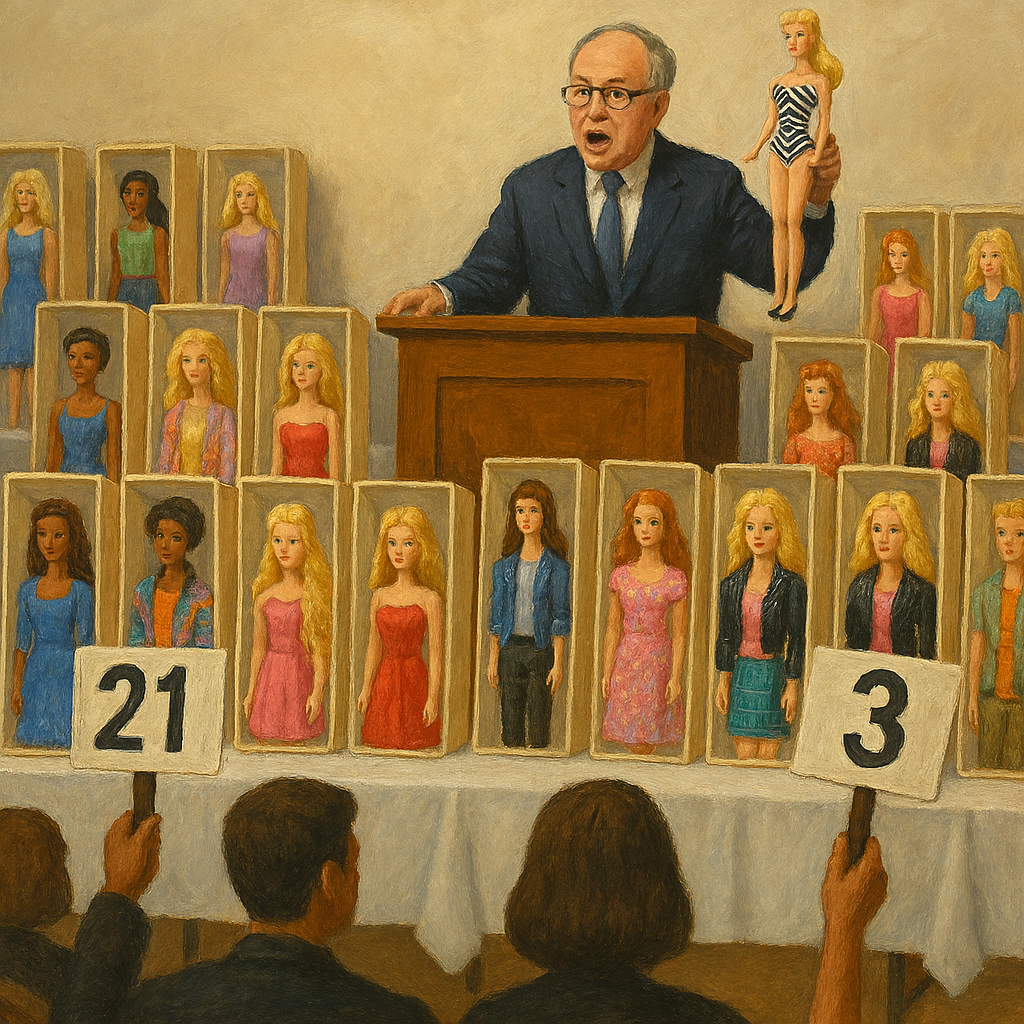
Barbie was introduced by Mattel in 1959, created by company co‑founder Ruth Handler. Handler observed that girls often played with paper dolls representing adult women and believed there was a market for a three‑dimensional adult doll. At the time, most dolls sold in the United States were infant dolls intended to encourage maternal play. Handler pushed for a fashion doll with adult features, interchangeable clothing, and articulated limbs. Mattel initially resisted the idea, but Handler persisted and used the German Bild‑Lilli doll as a manufacturing reference. Barbie debuted at the New York Toy Fair wearing a black‑and‑white swimsuit.
Despite poor initial reception from male buyers at the Toy Fair, Barbie sold strongly once placed in stores. By the mid‑1960s, Barbie had become a major commercial success, contributing significantly to Mattel’s growth. Over the decades, Barbie’s careers expanded to reflect a wide range of professions, including astronaut (1965), surgeon (1973), and presidential candidate (starting in 1992).
Barbie has also been the subject of criticism. In the late 1960s and 1970s, feminist groups objected to her proportions, consumerism, and perceived reinforcement of gender stereotypes. In response to evolving cultural expectations, Mattel made periodic design changes, including shifting Barbie’s eyes from a downward gaze to a forward gaze in 1971.
In 1980, Mattel released the first official African American Barbie. Over time, the brand expanded to include more skin tones, hair textures, and facial sculpts. Between 2012 and 2014, Barbie sales declined by approximately 20 percent, prompting Mattel to introduce three new body types—petite, tall, and curvy—in 2016. In 2019, the line expanded again to include dolls with wheelchairs, prosthetic limbs, and additional body shapes.
Barbie remains one of the most widely recognized toy brands in the world, with Mattel reporting global brand awareness near 99 percent and annual sales exceeding 58 million dolls. The brand continues to evolve its product line to reflect broader representation and accessibility while maintaining its position as a leading fashion doll in the United States.